



What is the price of ferrosilicon 75 today? Ferro-silicon 75% Si min export, fob China, $/tonne
| Today's price of ferrosilicon exported from China | |
| Unit: US dollars/ton | |
| product | Quotation |
| Ferrosilicon 72 | 1020-1040 |
| Ferrosilicon 75 | 1100-1120 |
1. How to Choose Between Iron Silicon 75 and 72
|
|
|
|
|---|---|---|
|
|
|
|
|
|
|
|
|
|
|
|
|
|
|
|
|
|
|
|
|
|
|
|
1.Target silicon addition – If the steel recipe requires higher Si concentration, FeSi 75 delivers more Si per unit weight, reducing handling and dosing frequency.
2.Process efficiency – FeSi 75's higher reactivity shortens melt treatment time, useful in high‑throughput mills.
3.Cost considerations – FeSi 72 is cheaper per ton; if steel specs allow lower Si, it offers cost savings.
4.Impurity sensitivity – Some grades of FeSi 75 have lower Al and trace elements, important for electrical steels; FeSi 72 may have slightly higher impurities.
5.Application type –
•FeSi 75: Preferred for electrical steel, tool steel, high‑strength automotive steels.
•FeSi 72: Sufficient for construction rebar, general carbon steel, and where moderate Si is adequate.
2. What is Ferro Silicon Calcium Used For?
|
|
|
|
|---|---|---|
|
|
|
|
|
|
|
|
|
|
|
|
|
|
|
|
•Calcium's strong reactivity with oxygen and sulfur gives deeper deoxidation and desulfurization than FeSi alone.
•Transforms hard, rigid Al₂O₃ inclusions into globular forms that float more easily.
•In cast iron, works with magnesium to improve nodule formation and mechanical properties.
•Enhances steel cleanliness and toughness.
•Reduces nozzle clogging in continuous casting by preventing high‑melting inclusions.
•Improves machinability and ductility in iron castings.
3. What is Silicon Manganese Used For?
|
|
|
|
|---|---|---|
|
|
|
|
|
|
|
|
|
|
|
|
|
|
|
|
•Dual alloying action: One addition provides both Mn and Si, reducing number of alloy batches.
•Desulfurization: Mn combines with S to form MnS, improving steel cleanliness.
•Carbon content: Medium‑carbon (1–2%) or low‑carbon grades available for specific steel specs.
•Cost‑effective for supplying two key elements at once.
•Improves steel's mechanical properties in fewer steps.
•Widely used in rebar, structural, and spring steel production.
Forms: Lump, crushed, or briquetted for furnace or ladle addition.
Visit https://www.metal-alloy.com/ to learn more about the product. If you would like to learn more about the product price or are interested in purchasing, please email market@zanewmetal.com. We will get back to you as soon as we see your message.
🏭 Why Choose ZhenAn?
ZhenAn is located in Anyang City, Henan Province, China, with 30 years of production experience, capable of manufacturing high-quality products per customer requirements.
ZhenAn has product experts, and the chemical composition, particle size, and packaging of products can be customized as per customer needs.
Each product has an annual production capacity of 60,000 tons, ensuring a stable supply and timely delivery.
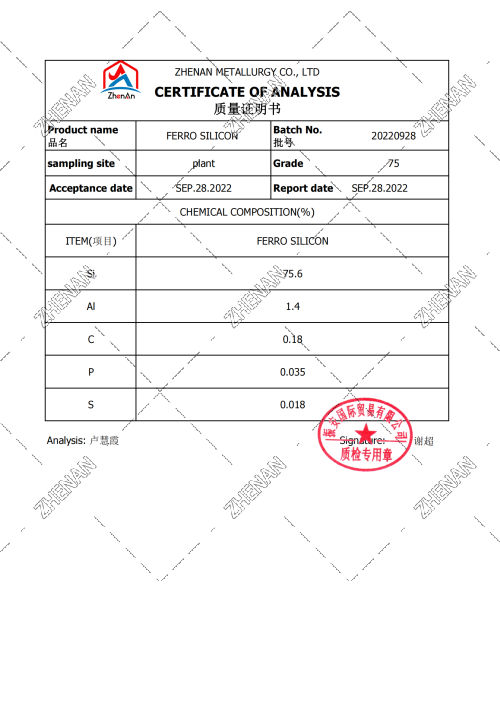
Strict quality control, with third-party inspections such as SGS and BV accepted.
We hold independent import and export qualifications.
Strict Quality Control
As a trustworthy supplier, Anyang ZhenAn ensures quality control, inspection, and technical services. We have a comprehensive quality control process throughout production, including:
- Chemical analysis of raw materials.
- Chemical analysis of molten material.
- Particle size distribution tests and other physical assessments.
- Chemical analysis before shipment.
All ferroalloy products are inspected by authoritative institutions and manufactured according to customer standards. We also accept third-party inspections at any time.
one-stop solution
professional team
high quality