



Properties of FeSi Nitride (Ferro Silicon Nitride): Composition, Metallurgical Benefits and Applications
Ferro Silicon Nitride (FeSiN) is a specialized silicon-iron-nitrogen ferroalloy used mainly in steelmaking, alloy production and advanced refractory applications. It combines the benefits of ferrosilicon with controlled nitrogen addition, providing silicon alloying, deoxidation and nitrogen-based strengthening effects.
The performance of FeSiN comes from its unique structure: a metallic iron-silicon matrix containing dispersed silicon nitride phases, which provides high-temperature stability and excellent metallurgical performance.
Chemical Composition of Ferro Silicon Nitride
Typical FeSiN composition includes:
| Element | Typical Range | Function |
|---|---|---|
| Silicon (Si) | 20–40 wt% | Deoxidation and alloying element |
| Iron (Fe) | Balance | Metallic matrix |
| Nitrogen (N) | 15–25 wt% | Grain refinement and precipitation strengthening |
| Aluminum (Al) | Minor amount | Controlled impurity |
| Calcium (Ca) | Minor amount | Controlled impurity |
| Carbon (C) | Minor amount | Depends on production process |
The exact composition varies depending on steel grade requirements and application conditions. Buyers should confirm specifications through the supplier's Certificate of Analysis (COA).
Physical and Chemical Properties of FeSiN
| Property | Typical Value / Description |
|---|---|
| Appearance | Gray metallic lumps, granules or fine gray powder |
| Density | Approximately 4.5–5.5 g/cm³ (depending on composition) |
| Decomposition temperature | Above approximately 1600°C; FeSiN does not have a traditional melting point |
| Hardness | Higher than conventional ferrosilicon; brittle solid structure |
| Thermal stability | Maintains structure up to approximately 1200°C under inert conditions |
| Electrical conductivity | Metallic conductivity due to iron-silicon phase |
| Reactivity | Reacts with strong oxidizers; nitrogen may release under oxidizing high-temperature conditions |
Key Metallurgical Properties of FeSiN
1. Efficient Deoxidation
Silicon in FeSiN reacts with oxygen in molten steel to form silicon oxide (SiO₂)-containing slag.
Benefits include:
Reduced dissolved oxygen
Improved steel cleanliness
Better control of steel chemistry
2. Silicon Alloying Effect
Silicon contributes to steel performance by improving:
Strength
Hardness
Elastic properties
Magnetic permeability
FeSiN provides a controlled silicon source for alloy steel production.
3. Nitrogen Addition and Grain Refinement
Nitrogen released from FeSiN can react with alloying elements such as:
Aluminum (Al)
Vanadium (V)
Titanium (Ti)
to form nitrides such as:
AlN
VN
TiN
These compounds contribute to:
Grain refinement
Precipitation strengthening
Improved mechanical properties
4. Cast Iron Structure Modification
In cast iron production, FeSiN can support graphite structure control.
Potential benefits include:
Promotion of spherical graphite formation
Improved mechanical properties of nodular iron
Better casting performance
FeSiN Applications in Refractory Systems
Although FeSiN is primarily a metallurgical additive, its high-temperature stability and mechanical strength allow it to be used in selected refractory applications.
| Application | Function in Refractory System | Benefit |
|---|---|---|
| Ladle and tundish working lining | Strengthening additive or hard aggregate | Improved abrasion resistance under molten steel flow |
| Slide gate plates and nozzles | Provides wear-resistant particles | Better thermal shock resistance and service durability |
| Tundish well blocks | Enhances high-temperature mechanical strength | Maintains structural stability during steel turbulence |
| Specialty castables | Reinforces monolithic refractory structures | Improved load-bearing capacity and reduced spalling |
FeSiN particles can act as reinforcing phases in ceramic-metal composite systems, improving resistance to:
Mechanical impact
Thermal cycling
High-temperature deformation
However, proper application design is important because excessive oxidation at high temperatures may reduce nitrogen retention and affect refractory performance.
FeSiN Handling and Storage
Handling requirements depend on product form.
Lump and Granule FeSiN
Advantages:
Lower dust generation
Easier transportation
Suitable for bulk furnace charging
Recommended practices:
Store in dry areas
Protect from moisture contamination
Avoid unnecessary crushing
FeSiN Powder
Advantages:
Faster reaction rate
Higher surface area
Required controls:
Dust collection systems
Appropriate respiratory protection
Sealed packaging
Fine powder should be handled carefully to maintain workplace safety and product stability.
How to Select the Right FeSiN Grade
When purchasing Ferro Silicon Nitride, buyers should evaluate:
| Parameter | Importance |
|---|---|
| Nitrogen content | Determines nitrogen addition efficiency |
| Silicon content | Controls alloying and deoxidation contribution |
| Particle size | Affects feeding behavior and reaction speed |
| Impurity levels | Influences steel cleanliness |
| Packaging | Prevents moisture absorption and contamination |
Get Reliable Ferro Silicon Nitride Supply
ZhenAn provides FeSiN products with:
✔ Controlled Si and N content
✔ Customized particle sizes
✔ Metallurgical and refractory application support
✔ Quality inspection documentation
✔ Export packing solutions
Contact ZhenAn for FeSiN specifications and quotation:
WhatsApp: +86 15518824805
Email: market@zanewmetal.com
FAQ About FeSi Nitride (Ferro Silicon Nitride)
1. What is Ferro Silicon Nitride (FeSiN) used for?
FeSiN is mainly used for:
Nitrogen alloying in steel production
Silicon addition and deoxidation
Grain refinement
Special refractory applications
It is especially valuable when controlled silicon and nitrogen addition are required.
2. What is the difference between FeSi and FeSiN?
The main difference is nitrogen content.
Ferro Silicon (FeSi): Mainly provides silicon for deoxidation and alloying.
Ferro Silicon Nitride (FeSiN): Provides silicon plus nitrogen, allowing additional strengthening and grain refinement effects.
3. Why is nitrogen important in steel production?
Nitrogen can combine with alloying elements such as Al, Ti and V to form nitrides. These compounds help refine grain size and improve mechanical properties.
4. Can FeSiN be used in refractory materials?
Yes. FeSiN can be used in selected refractory systems, especially where improved wear resistance, thermal stability and mechanical strength are required.
5. What particle sizes are available for FeSiN?
Common forms include:
Lump
Granule
Powder
The suitable particle size depends on furnace charging method, alloying process and refractory formulation.
6. How should FeSiN be stored?
FeSiN should be stored in a dry environment with protection from moisture and contamination. Powder products require sealed packaging and dust-control measures.
7. What should buyers check before purchasing FeSiN?
Important quality parameters include:
Silicon content
Nitrogen content
Particle size
Impurity levels
Certificate of Analysis (COA)
Batch consistency
Visit https://www.metal-alloy.com/ to learn more about the product. If you would like to learn more about the product price or are interested in purchasing, please email market@zanewmetal.com. We will get back to you as soon as we see your message.
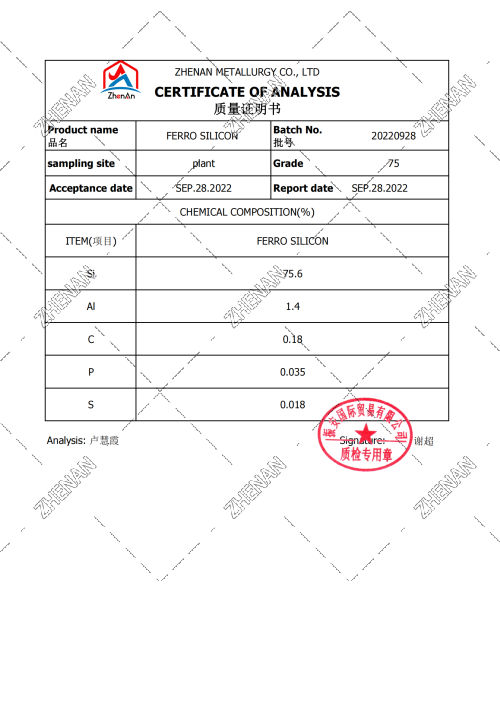
🏭 Why Choose ZhenAn?
We have a strong foundation and a customer-focused service attitude. Our products are exported to Europe, Asia, Africa, Australia, and South America, earning high customer satisfaction.
Additionally, we have a professional R&D and sales team, as well as our own factory and laboratory.
Each batch of products undergoes rigorous inspection by our quality control team.
After passing a series of tests, our products are delivered to customers, ensuring quality assurance.
We offer customized products with different contents, standards, and specifications tailored to customer needs.
• Competitive prices
• Stock goods in multiple specifications
• Years of production and export experience
• Mature R&D and quality inspection teams ensuring stable and high quality
24-Hour Online Service
• Inquiries will be responded to within 2 hours.
• Fastest delivery times.
• Comprehensive thin-film analysis, material supply, and problem-solving services during the coating process.
• R&D services for customized new evaporation materials.
• ISO 9001:2008 and SGS certified; purity tested and safely transported.
one-stop solution
professional team
high quality