
Advantages of FeSi70: lower cost, but does it provide sufficient deoxidizing effect for ordinary steel?

Dec 18, 2025

Leave a message

FeSi70​ (Ferro Silicon with ~70% silicon) indeed offers notable cost advantages​ compared with some other deoxidizers (such as pure silicon metal or aluminum-based products) while still being an effective deoxidizer​ for ordinary steelmaking. However, whether it provides sufficientdeoxidizing power depends on the steel grade, process conditions, and the required final oxygen level. Let's break this down:

1. Deoxidizing Mechanism of FeSi70

Silicon has a strong affinity for oxygen​ and reacts with dissolved oxygen in molten steel:

[Si]+2[O]→SiO2​

The silica (SiO₂) forms slag, which floats and is removed.
FeSi70 typically contains about 70% Si, so its deoxidizing capacity is lower per unit weight than pure silicon (~100% Si), but higher than many low‑silicon ferrosilicons (e.g., FeSi45).

2. Cost Advantage

Lower raw material cost: FeSi70 is cheaper than pure silicon metal and often more economical than aluminum when used for moderate deoxidation levels.
Convenient form: As briquettes or lumps, it is easy to handle and dose in bulk steelmaking, reducing labor and processing costs.
Dual function: Apart from deoxidation, it simultaneously adds silicon as an alloying element, saving a separate silicon addition step.

3. Effectiveness in Ordinary Steelmaking

For ordinary carbon steels​ (e.g., structural steel, rebar, ship plate), FeSi70 is fully capable​ of achieving the typical oxygen levels required for clean, sound castings.
In basic oxygen furnace (BOF)​ or electric arc furnace (EAF)​ tapping, FeSi70 is commonly added in the ladle to bring oxygen down to acceptable levels for continuous casting or ingot casting.
However, for ultra‑low oxygen steels​ (e.g., certain high‑toughness plate, bearing steel, or IF steel), additional strong deoxidizers (like aluminum or calcium silicon) may be needed after FeSi70 to reach the stricter limits.

4. Comparison With Other Deoxidizers

Deoxidizer
Si Content
Relative Deoxidizing Strength
Cost
Typical Use
FeSi70​
~70%
Moderate–Strong
Low–Moderate
Ordinary carbon & low‑alloy steels
Pure Si​
~100%
Strong
Higher
Precise alloying/deoxidation
Al​
~100% Al
Very Strong (fast)
Higher
Final deoxidation (kill steel)
CaSi​
Ca + Si
Strong, modifies inclusions
Higher
Cleanliness-critical steels
FeSi70 sits in the middle ground: enough for most ordinary steel, but not as aggressive or inclusion‑modifying as Al or CaSi.

5. Practical Considerations

Addition timing: Late addition in the ladle ensures effective deoxidation without excessive re‑oxidation.
Slag control: SiO₂ formation changes slag chemistry; if basic slag is too low, silica may persist and affect desulfurization.
Temperature effect: Silicon deoxidation is exothermic, slightly increasing bath temperature - helpful in certain processes.

6. Conclusion

Yes, FeSi70 provides sufficient deoxidizing effect​ for ordinary steelmaking (carbon steels, low‑alloy steels, rebar, etc.) at a lower cost​ than pure silicon or aluminum.
It is the standard deoxidizer and alloying agent​ in many steel plants for these grades.
For steels requiring very low oxygen​ or strict inclusion control, FeSi70 may be used as a pre‑deoxidizer, followed by stronger agents like aluminum or calcium silicon for final killing.

So, in summary: FeSi70 = cost‑effective + sufficiently strong deoxidizer for ordinary steel, but not necessarily the final solution for all high‑cleanliness or specialty steel grades.


Visit https://www.metal-alloy.com/ to learn more about the product. If you would like to learn more about the product price or are interested in purchasing, please email market@zanewmetal.com. We will get back to you as soon as we see your message.
 

Get a Quote Today


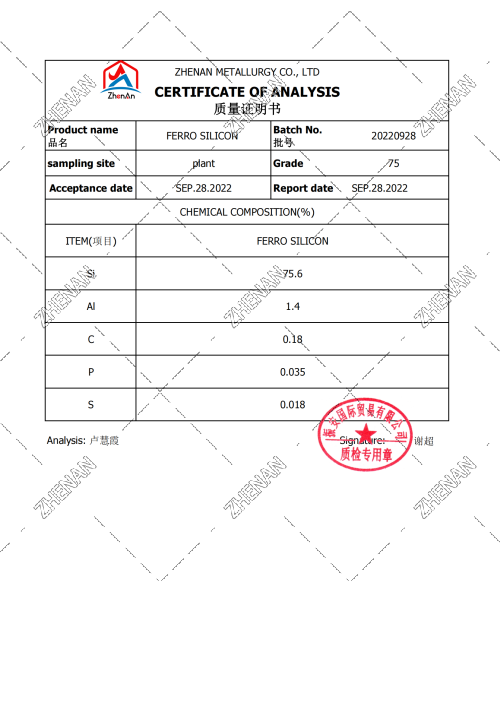
Iron Silicon Alloy With 75 Silicon Silver Grey Powder For High Strength Alloy Steel Making

🏭 Why Choose ZhenAn?


We understand the common pain points in current product procurement:
•High local cost and unstable supply
•Long lead times affecting project schedules
•Incomplete product ranges
•Slow communication and lack of follow-up


We Help Solve These Problems With:
✅ Large stock ready for fast delivery
✅ One-stop sourcing for Ferro Silicon, silicon metal, Silicon Metal Powder , and more
✅ Strict quality control with international standards
✅ Experienced sales team with fast response and clear communication

We'd love to learn more about your needs and offer you competitive prices and efficient service.
 

one-stop solution

professional team

high quality

Q: Use of electrolytic manganese flake in manganese alloy manufacturing?
A: Serves as raw material for producing silicomanganese and other manganese alloys.

Q: Electrolytic manganese flake in battery materials nickel manganese cobalt?
A: Provides high-purity manganese for NMC cathode materials in lithium-ion batteries.

Q: Electrolytic manganese flake for aluminum manganese alloy production?
A: Added to molten aluminum to produce Al-Mn alloys for can stock and architectural applications.

Q: Importance of electrolytic manganese flake in chemical catalysts?
A: Used as catalyst or precursor in organic synthesis and oxidation reactions.

Q: International standards for electrolytic manganese flake ASTM ISO?
A: Covered under ASTM B94 for manganese metal; ISO standards specify composition and quality requirements.

Q: National standard of electrolytic manganese flake in China GB?
A: GB/T 3418 defines grades, chemical composition, and test methods.

Q: Purity grades of electrolytic manganese flake common specifications?
A: Common grades: EMn99.7, EMn99.9; higher purities for battery and specialty uses.

Q: Acceptable impurity limits in electrolytic manganese flake?
A: Fe, S, P, Si, C typically below 0.05–0.1% depending on grade.

Q: Testing methods for electrolytic manganese flake purity and composition?
A: ICP-OES, XRF, titration, and combustion analysis for carbon and sulfur.

Q: Electrolytic manganese flake price per ton today market trend?
A: Prices vary with ore and energy costs; recent range approx. 1800–2400/ton.

Q: Global electrolytic manganese flake market size and forecast?
A: Multi-million ton market growing with battery and steel demand, especially in Asia.

Q: Major electrolytic manganese flake producing countries China South Africa?
A: China dominates (>90% of global output); South Africa and Brazil have smaller shares.