



What is the price of ferrosilicon 75 today? Ferro-silicon 75% Si min export, fob China, $/tonne
| Today's price of ferrosilicon exported from China | |
| Unit: US dollars/ton | |
| product | Quotation |
| Ferrosilicon 72 | 1020-1040 |
| Ferrosilicon 75 | 1100-1120 |
1. What is Iron Silicon 75 Used For?
|
|
|
|
|---|---|---|
|
|
|
|
|
|
|
|
|
|
|
|
|
|
|
|
|
|
|
|
•Deoxidation: In molten steel, Si reacts with O to form silica, which floats as slag, removing dissolved gases and preventing porosity.
•Alloying: Silicon enhances hardenability, strength, and elastic modulus in structural and tool steels.
•Graphite control: In cast irons, FeSi 75 modifies graphite morphology, preventing brittle structures and improving ductility.
•Welding: Acts as a scavenger for oxygen and helps produce clean, strong weld beads with smooth contours.
•Electrical steels: Si improves magnetic permeability and reduces hysteresis losses, critical for transformers and electric motors.
2. What Are the Grades of Iron Silicon 75?
|
|
|
|
|
|
|---|---|---|---|---|
|
|
|
|
|
|
|
|
|
|
|
|
|
|
|
|
|
|
|
|
|
|
|
|
•Standard FeSi 75: General purpose for steel deoxidation and alloying.
•Low Al grade: Used when aluminium pickup must be minimized (e.g., in deep‑drawing steels).
•High Purity grade: Required for electrical steels, stainless steels, and other high‑grade alloys where trace elements affect performance.
•Briquette form: Easier to handle and dose automatically; reduces airborne dust during charging.
•Choose grade based on target silicon level, acceptable impurity profile, and process requirements (e.g., powder for rapid dissolution, briquette for controlled feeding).
•Matching grade to application ensures optimal metallurgical results and cost efficiency.
These grades make Iron Silicon 75 adaptable to a wide range of steel, foundry, and advanced material applications.
3. What is the Difference Between Silicon and Iron Silicon 75?
|
|
|
|
|---|---|---|
|
|
|
|
|
|
|
|
|
|
|
|
|
|
|
|
|
|
|
|
|
|
|
|
|
|
|
|
•Composition: FeSi 75 contains iron, altering physical properties and reducing cost.
•Reactivity: Pure silicon is more reactive; FeSi 75 is less prone to fuming and oxidation during addition to molten metal.
•Applications: Silicon metal is for high‑purity tech uses; FeSi 75 is for bulk metallurgy where iron contamination is acceptable or beneficial.
•Cost: FeSi 75 is cheaper for achieving silicon's metallurgical effects in steel and iron production.
Visit https://www.metal-alloy.com/ to learn more about the product. If you would like to learn more about the product price or are interested in purchasing, please email market@zanewmetal.com. We will get back to you as soon as we see your message.
🏭 Why Choose ZhenAn?
ZhenAn is located in Anyang City, Henan Province, China, with 30 years of production experience, capable of manufacturing high-quality products per customer requirements.
ZhenAn has product experts, and the chemical composition, particle size, and packaging of products can be customized as per customer needs.
Each product has an annual production capacity of 60,000 tons, ensuring a stable supply and timely delivery.
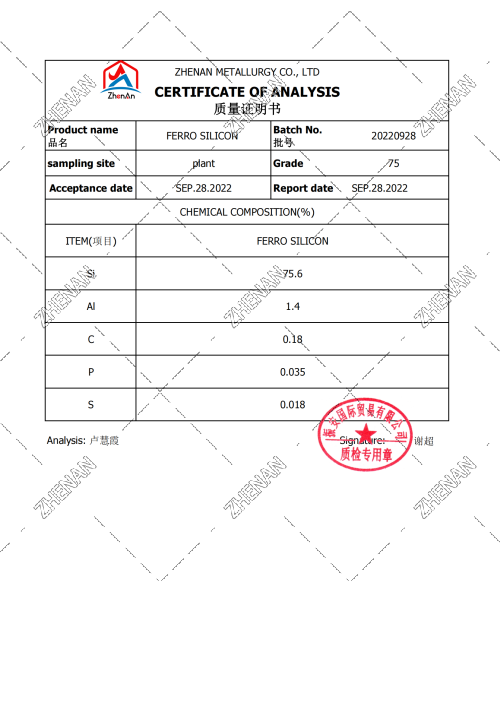
Strict quality control, with third-party inspections such as SGS and BV accepted.
We hold independent import and export qualifications.
Strict Quality Control
As a trustworthy supplier, Anyang ZhenAn ensures quality control, inspection, and technical services. We have a comprehensive quality control process throughout production, including:
- Chemical analysis of raw materials.
- Chemical analysis of molten material.
- Particle size distribution tests and other physical assessments.
- Chemical analysis before shipment.
All ferroalloy products are inspected by authoritative institutions and manufactured according to customer standards. We also accept third-party inspections at any time.
one-stop solution
professional team
high quality