
What Are The Melting Point And Density Of FeSi75 Ferro Silicon75 ?

Dec 12, 2025

Leave a message


What Are the Melting Point and Density of FeSi75?​

Key Physical Properties for Handling and Metallurgy
Property
Value
Remarks
Chemical composition​
~73–78 % Si, balance mainly Fe (small amounts of Al, Ca, etc.)
Nominal "75" indicates typical Si content.
Melting point​
~1200–1300 °C​ (range depends on exact Si/Fe ratio)
Lower than pure iron (~1538 °C); melts well before steelmaking tapping temperature (~1600 °C).
Density​
~3.5–4.0 g/cm³​ (approx. 3.7 g/cm³ typical)
Lighter than steel (~7.8 g/cm³), so floats in molten metal if not stirred properly.
Thermal conductivity​
Moderate; aids in faster dissolution in melt.
Important for predicting dissolution rate in ladle or furnace.
Practical notes:
The melting range is wide because FeSi75 is a metallurgical alloy, not a pure compound.
During steelmaking, FeSi75 dissolves rapidly once molten, helping distribute Si evenly.
Its lower density means it must be added carefully to avoid floating on the surface and slow incorporation.


What Particle Size Options Are Available for FeSi75 (Lump, Powder, Granule)?​

 Forms for Different Steelmaking Processes
Form
Typical Size Range
Characteristics
Common Applications
Lump​
~10–50 mm
Large pieces, slower dissolution, minimal dust
Bulk additions in furnace tapping, open‑hearth, BOF where time allows complete melting.
Granule / Chip​
~3–10 mm
Medium dissolution rate, less dust than powder
Ladle additions, continuous casting tundish treatment, better control of alloying.
Powder​
< 3 mm, often < 1 mm
Fast dissolution, high surface area, generates fume/dust
Specialty treatments (e.g., wire feeding, injection), rapid deoxidation in small batches.
Briquette​
Custom shape/size (often ~30–80 mm)
Compressed lumps, reduces dust, consistent weight
Easier handling in automated charging systems, less segregation.

Selection Factors

Dissolution rate: Powder > granule > lump.
Fume/dust: Powder highest; lump lowest.
Process safety: Coarser forms minimize inhalation hazards.
Automation: Briquettes or granules preferred for precise dosing.
Application:
Furnace tap: Lump acceptable due to long residence time.
Ladle: Granules/briquettes ensure full dissolution before casting.
Wire feeding: Fine powder encapsulated in steel sheath for controlled release.


What Are the Impurity Levels (Al, Ca, S, P) in Industrial‑Grade FeSi75?​

Typical Compositional Ranges in Commercial Grades
Industrial FeSi75 is produced in various grades; impurity contents depend on raw materials and production method (electric arc furnace). Below are typical ranges​ for standard commercial grades used in steelmaking.
Element
Typical Content in FeSi75
Effect on Steel
Notes
Aluminum (Al)​
0.5–2.0 %​ (sometimes up to 3 % in low‑grade)
Can form hard Al₂O₃ inclusions; undesirable in high‑purity steel
Some producers offer low‑Al FeSi75(< 0.5 %) for cleaner steel.
Calcium (Ca)​
0.1–0.5 %​ (occasionally higher if added intentionally)
Modifies inclusion composition to more globular shapes
Ca presence helps flotation of silicates in slag.
Sulfur (S)​
≤ 0.02–0.05 %​ (max 0.03 % common)
Harmful in most steels (promotes hot shortness)
Controlled via raw material selection.
Phosphorus (P)​
≤ 0.03–0.06 %​ (max 0.04 % common)
Undesirable in many structural/alloy steels
Limited by charge materials and reduction practice.
Carbon (C)​
Trace (~0.1 % or less)
Minor effect in most steels
May be higher in certain carbothermic routes.
Iron (Fe)​
Balance (~20–25 %)
Main matrix element
Determines density and melting characteristics.

Special Grades

Low‑Al FeSi75: Al ≤ 0.5 %, used for electrical steels and stainless steels.
High‑Purity FeSi75: Al ≤ 0.3 %, S/P ≤ 0.01 %, tailored for critical applications.
Standard Grade: Al ~1–2 %, acceptable for general carbon steels where inclusion control is managed by slag practice.


Quick Reference Summary Table

Question
Key Data
Melting point & density
MP ≈ 1200–1300 °C; Density ≈ 3.5–4.0 g/cm³
Particle size options
Lump (10–50 mm), Granule (3–10 mm), Powder (< 3 mm), Briquette (custom)
Impurity levels (industrial grade)
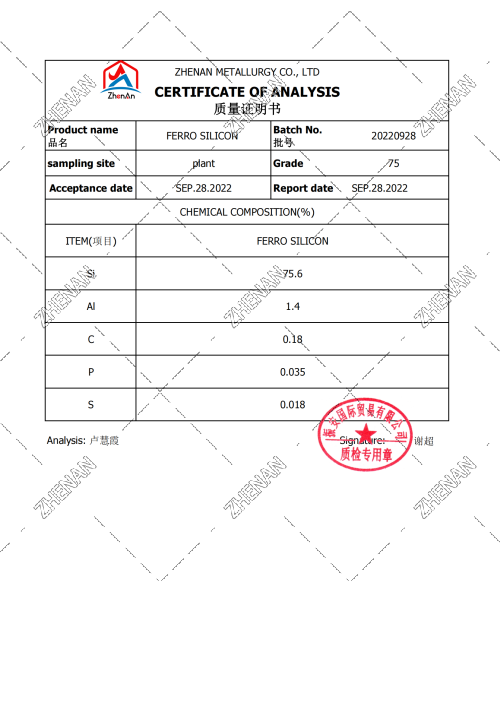
Al: 0.5–2 %; Ca: 0.1–0.5 %; S: ≤ 0.03 %; P: ≤ 0.04 % (typical ranges)


Ferrosilicon FAQ

China Metallurgy Application Ferro Silicon / Ferrosilicon for Pure Ferro Silicon 75% for Steel and Iron Industry at Competitive Prices

Ferro Silicon 75
Ferro Silicon
Ferro Silicon
Ferro Silicon
Q: CO₂ emissions from ferrosilicon smelting?​

A: Significant; from carbon reductant reacting with oxygen.


Q: Recycling or waste management in ferrosilicon plants?​

A: Slag reuse, dust collection, emission control systems.


Q: How to reduce slag formation when adding ferrosilicon in steelmaking?​

A: Add evenly, control timing, use suitable slag cover.


Q: Problems caused by excessive silicon in steel?​

A: Reduced ductility, toughness, weldability.


Q: Storage and handling precautions for ferrosilicon?​
A: Keep dry, avoid moisture (can cause hydrogen), protect from impact.


Visit https://www.metal-alloy.com/ to learn more about the product. If you would like to learn more about the product price or are interested in purchasing, please email market@zanewmetal.com. We will get back to you as soon as we see your message.
 

Get a Quote Today


Iron Silicon Alloy With 75 Silicon Silver Grey Powder For High Strength Alloy Steel Making

🏭 Why Choose ZhenAn?


We understand the common pain points in Ferro Silicon sourcing today:
•High local cost and unstable supply
•Long lead times affecting project schedules
•Incomplete product ranges
•Slow communication and lack of follow-up


We Help Solve These Problems With:
✅ Large stock ready for fast delivery
✅ One-stop sourcing for Ferro Silicon, silicon metal, Silicon Metal Powder , and more
✅ Strict quality control with international standards
✅ Experienced sales team with fast response and clear communication

We'd love to learn more about your needs and offer you competitive prices and efficient service.
 

one-stop solution

professional team

high quality