
What is Ferro Silicon 70 (FeSi70)?

Dec 18, 2025

Leave a message

What is Ferro Silicon 70 (FeSi70)?

Ferro Silicon 70 (FeSi70)​ is a ferroalloy composed of iron (Fe)​ and silicon (Si), with silicon making up approximately 70% by weight. The remaining ~30% is primarily iron, along with trace amounts of other elements like aluminum (Al), calcium (Ca), carbon (C), phosphorus (P), and sulfur (S).
It is one of several standard grades of ferrosilicon, differentiated by their silicon content:
FeSi15 / FeSi25:​ Low-silicon grades.
FeSi45 / FeSi50 / FeSi65:​ Medium-silicon grades.
FeSi70 / FeSi75 / FeSi90:​ High-silicon grades.
The "70" denotes its high silicon concentration, which gives it powerful deoxidizing and alloying properties. It appears as a lustrous, metallic gray solid, often found in lump or crushed form.

Primary Roles and Functions in Industry

The main roles of FeSi70 stem from the chemical properties of silicon: its strong affinity for oxygen and its ability to modify the properties of steel and cast iron.

1. Deoxidation in Steelmaking

This is the most critical application. During the conversion of molten iron into steel in a Basic Oxygen Furnace (BOF) or Electric Arc Furnace (EAF), dissolved oxygen remains in the metal, which would make the final product brittle and weak.
How it works:​ Silicon has a very high affinity for oxygen. When FeSi70 is added to the molten steel, the following reaction occurs:
2[Si] + 3[O] -> Si₂O₃
Result:​ The silicon reacts with the dissolved oxygen to form silica (SiO₂), which floats to the surface as slag and is removed. This process is called deoxidation.
Why FeSi70?​ Its high silicon content (70%) means less material needs to be added to achieve the same level of deoxidation compared to lower-grade ferrosilicons, making it highly efficient and cost-effective for large-scale steel production.

2. Alloying Agent in Steel and Cast Iron

Silicon is a crucial alloying element that fundamentally changes the properties of metals.
In Steel:
Strength and Hardness:​ Increases tensile strength and hardness.
Electrical Properties:​ Increases electrical resistivity, making it useful for electrical steels and transformer laminations.
Magnetic Properties:​ Enhances magnetic permeability in silicon steels used for electric motors and generators.
Corrosion Resistance:​ Contributes to the formation of protective oxide layers.
In Cast Iron:
Graphite Formation:​ Promotes the formation of graphite flakes, transforming brittle white cast iron into tougher, machinable gray cast iron.
Nodularization:​ In combination with magnesium or cerium, it helps produce ductile (nodular) iron, which has high strength and excellent ductility.

3. Inoculation of Cast Iron

Immediately after casting, molten cast iron is "inoculated" by adding a small amount of a high-silicon alloy like FeSi70 (or a specialized inoculant). This provides nucleation sites for graphite formation.
Purpose:​ Prevents the formation of chill (white iron) in thin sections of the casting, ensuring uniform structure and mechanical properties throughout the component.

4. Production of Other Ferroalloys

FeSi70 is used as a raw material in the production of other ferroalloys, such as ferromanganese​ and silicon-metal, where a controlled source of silicon is required.

Advantages of Using FeSi70

High Efficiency:​ Due to its 70% silicon content, it requires less mass to be added for the same chemical effect, reducing handling and processing time.
Cost-Effectiveness:​ For deoxidation and alloying tasks, it offers a better silicon-to-iron ratio than lower-grade ferrosilicons.
Purity:​ It typically has low levels of undesirable tramp elements like phosphorus and sulfur, which is critical for producing high-quality steel.
Versatility:​ It serves multiple functions-deoxidation, alloying, and inoculation-across various metallurgical processes.

Typical Applications Table

Industry
Application
Role of FeSi70
Steelmaking
Deoxidation in BOF/EAF
Removes oxygen to prevent brittleness; improves steel cleanliness.
Steelmaking
Production of Electrical Steel
Increases electrical resistivity and magnetic permeability.
Foundry (Cast Iron)
Production of Gray Iron
Promotes graphite flake formation for toughness and machinability.
Foundry (Cast Iron)
Production of Ductile Iron
Acts as an alloying base for creating spheroidal graphite.
Foundry (Cast Iron)
Inoculation
Prevents chill formation and ensures uniform casting quality.
Chemical Industry
Source of Silicon
Used in the production of silicones and other silicon-based chemicals (after processing).


Summary

Ferro Silicon 70 (FeSi70)​ is a vital high-silicon ferroalloy in modern metallurgy. Its primary role is as a powerful and efficient deoxidizer​ in steelmaking, ensuring the production of clean, strong steel. Additionally, it is an essential alloying agent​ for both steel and cast iron, imparting critical properties like strength, electrical characteristics, and machinability. Its high silicon content makes it a cornerstone material for industries ranging from construction and automotive to electronics and heavy machinery.

Visit https://www.metal-alloy.com/ to learn more about the product. If you would like to learn more about the product price or are interested in purchasing, please email market@zanewmetal.com. We will get back to you as soon as we see your message.
 

Get a Quote Today


Iron Silicon Alloy With 75 Silicon Silver Grey Powder For High Strength Alloy Steel Making

🏭 Why Choose ZhenAn?


We understand the common pain points in current product procurement:
•High local cost and unstable supply
•Long lead times affecting project schedules
•Incomplete product ranges
•Slow communication and lack of follow-up


We Help Solve These Problems With:
✅ Large stock ready for fast delivery
✅ One-stop sourcing for Ferro Silicon, silicon metal, Silicon Metal Powder , and more
✅ Strict quality control with international standards
✅ Experienced sales team with fast response and clear communication

We'd love to learn more about your needs and offer you competitive prices and efficient service.
 

one-stop solution

professional team

high quality

Q: What is Ferro Silicon 70 (FeSi70)?
A: An iron–silicon alloy with ~70% Si, used for deoxidation and alloying in general steelmaking and foundries.

Q: Chemical composition of FeSi70 (typical Si, Fe, and impurity levels)?
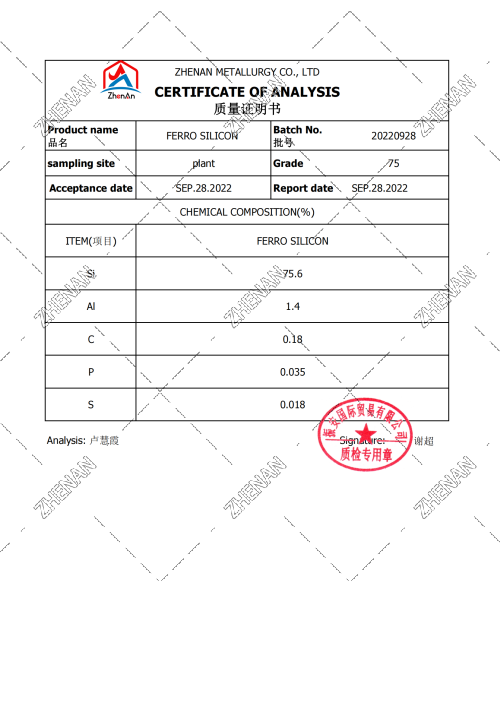
A: ~68–72% Si, balance Fe, impurities: Al ≤ 2%, Ca ≤ 1%, C ≤ 0.2%, P ≤ 0.04%, S ≤ 0.02%.

Q: Is FeSi70 a recognized industrial grade? ASTM/GB standards?
A: Not in ASTM A1006; covered in GB/T 2272 (China) and ISO 5448 as a medium‑Si grade.

Q: Silicon content range for FeSi70 (e.g., 68–72%)?
A: Typically 68–72% Si, nominal 70%.

Q: Difference between FeSi70 and FeSi72 (Si content, cost, deoxidation efficiency)?
A: FeSi70 lower Si, lower cost, slightly less efficient deoxidation than FeSi72.

Q: FeSi70 vs FeSi65: Which is better for low-silicon steel production?
A: FeSi65 better for very low Si targets; FeSi70 gives more Si per unit, so must be dosed carefully.

Q: Why choose FeSi70 over higher silicon grades in cost-sensitive applications?
A: Lower purchase price, sufficient Si for standard requirements, reduced alloy cost.

Q: Applications of FeSi70 in general steelmaking (e.g., carbon steel deoxidation)?
A: Removes oxygen in BOF/EAF, adjusts Si in carbon steels.

Q: Use of FeSi70 in foundry for heavy-section cast iron?
A: Inoculation to prevent chill, promote uniform graphite.

Q: Role of FeSi70 in non-ferrous alloy production (e.g., copper alloying)?
A: Adds Si to Cu alloys for improved fluidity and strength.

Q: Cost-effective use of FeSi70 in small-scale steel mills?
A: Meets deoxidation needs at lower cost than high-Si grades, simpler inventory.

Q: Advantages of FeSi70: lower cost and sufficient deoxidation for common steel?
A: Economical choice for standard steel grades, adequate performance.