


| Today's price of ferrosilicon exported from China | |
| Unit: US dollars/ton | |
| product | Quotation |
| Ferrosilicon 72 | 1020-1040 |
| Ferrosilicon 75 | 1100-1120 |
Q: What is the price range for ferrosilicon 72 today?
A: It's about 1020 to 1040 US dollars per ton.
Q: And how much is ferrosilicon 75?
A: Ferrosilicon 75 costs around 1100 to 1120 US dollars per ton.
Q: Is ferrosilicon 75 more expensive than 72?
A: Yes, it's higher, because 75 is priced above 1100 dollars, while 72 is below 1050 dollars.
Q: Are these prices for export from China?
A: Yep, they are the export prices from China today.
Q: What unit is used for these prices?
A: They are in US dollars per ton.
Q: Which one would be cheaper if I buy ferrosilicon today?
A: Ferrosilicon 72 is cheaper, since its price starts at 1020 dollars, lower than 75's starting point of 1100 dollars.

What is FeSi?
|
|
|
|---|---|
|
|
|
|
|
|
|
|
|
|
|
|
Primary Functions
•Deoxidizer: Reacts with oxygen in molten steel to form SiO₂ slag, purifying the metal.
•Alloying Agent: Adds silicon to improve strength, magnetic properties, and corrosion resistance.
•Inoculant: In cast iron, promotes graphite formation and prevents chill zones.
•Steelmaking (especially HSLA, electrical, and tool steels)
•Foundry inoculants for gray and ductile iron
•Dense media separation in mining
•Production of silicones and other silicon chemicals (as a silicon source)
What is FeSi in Mining?
|
|
|
|
|---|---|---|
|
|
|
|
|
|
|
|
|
|
|
|
•FeSi particles are mixed with water to form a dense slurry.
•Feed material is introduced; lighter particles float, heavier ones sink.
•FeSi's controllable density (via grade selection) matches target separation densities.
•Chemically inert in process water.
•Available in various densities (choose FeSi 65 for ~2.8 g/cm³, FeSi 90 for >3.0 g/cm³).
•Recyclable and reusable, reducing operating cost.

In coal washing, FeSi DMS removes ash-forming minerals; in diamond mining, it separates gem‑quality stones from host rock. Its brittleness is advantageous-it breaks into fines that remain suspended without affecting separation sharpness.
What is the Composition of FeSi?
|
|
|
|
|
|
|---|---|---|---|---|
|
|
|
|
|
|
|
|
|
|
|
|
|
|
|
|
|
|
|
|
|
|
|
|
|
|
|
|
|
|
•Main Elements: Silicon and iron; silicon percentage dictates alloy properties and applications.
•Minor Elements: Aluminum, calcium, carbon, manganese may appear as residuals from production.
•Impurities: Strict limits on phosphorus and sulfur to avoid steel contamination.
•Forms: Lump, crushed, granulated, or briquetted for ease of handling and dosing.
•Deoxidizing power (higher Si = stronger oxygen removal).
•Melting behavior (lower Fe content reduces density and melting point).
•Cost (higher Si grades require more quartz and energy to produce).
By selecting the right FeSi grade, metallurgists tailor steel and iron chemistries precisely for strength, toughness, and manufacturability.
Visit https://www.metal-alloy.com/ to learn more about the product. If you would like to learn more about the product price or are interested in purchasing, please email market@zanewmetal.com. We will get back to you as soon as we see your message.
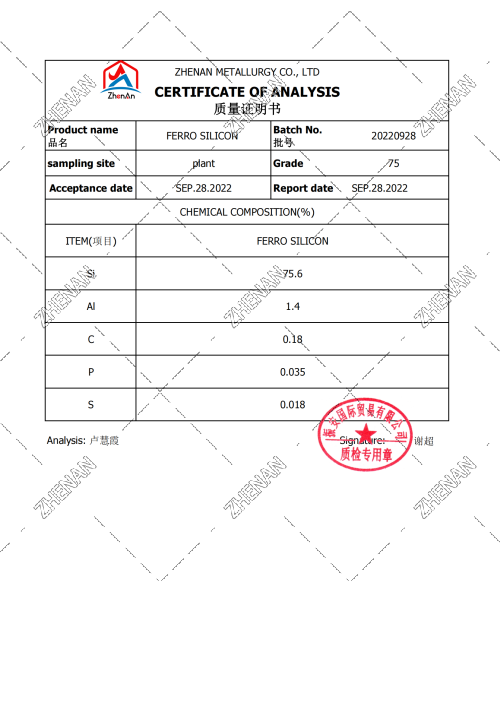
🏭 Why Choose ZhenAn?
We have a strong foundation and a customer-focused service attitude. Our products are exported to Europe, Asia, Africa, Australia, and South America, earning high customer satisfaction.
Additionally, we have a professional R&D and sales team, as well as our own factory and laboratory.
Each batch of products undergoes rigorous inspection by our quality control team.
After passing a series of tests, our products are delivered to customers, ensuring quality assurance.
We offer customized products with different contents, standards, and specifications tailored to customer needs.
• Competitive prices
• Stock goods in multiple specifications
• Years of production and export experience
• Mature R&D and quality inspection teams ensuring stable and high quality
one-stop solution
professional team
high quality