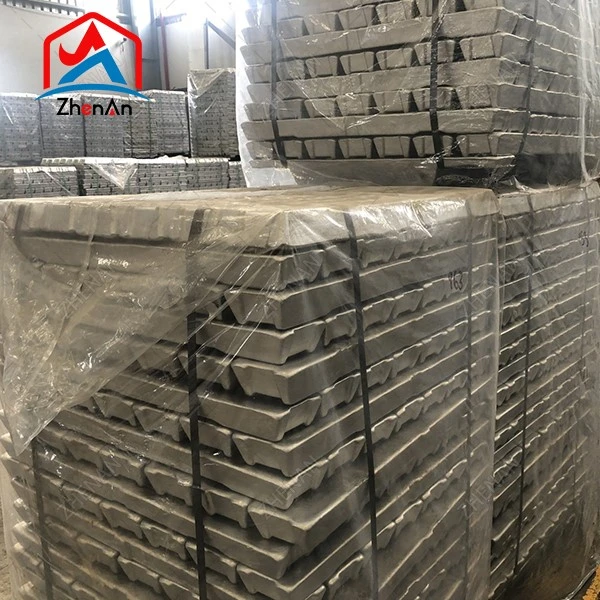
What is the tin ingot processing technology?
Tin ingot processing technology refers to a series of processing processes for the original tin ingots to process them into finished products of various specifications and shapes. The tin ingot processing technology usually includes a series of process steps such as material preparation, smelting, casting, forging, rolling, stretching and annealing.
Product Parameters
| Item | Sn 99.90 | Sn 99.95 | Sn 99.99 |
| Sn %≥ | 99.9 | 99.95 | 99.99 |
| As %≤ | 0.008 | 0.003 | 0.0005 |
| Fe %≤ | 0.007 | 0.004 | 0.002 |
| Cu %≤ | 0.008 | 0.004 | 0.0005 |
| Pb %≤ | 0.032 | 0.02 | 0.0035 |
| Bi %≤ | 0.015 | 0.006 | 0.0025 |
| Sb %≤ | 0.02 | 0.014 | 0.0015 |
| Cd %≤ | 0.0008 | 0.0005 | 0.0003 |
| Zn %≤ | 0.001 | 0.0008 | 0.0003 |
| Al %≤ | 0.001 | 0.0008 | 0.0005 |
| S %≤ | 0.0005 | 0.0005 | 0.0003 |
| Ag %≤ | 0.005 | 0.0001 | 0.0001 |
| Ni+Co %≤ | 0.005 | 0.005 | 0.0006 |
First, material preparation is required to select high-quality raw tin ingots to ensure that their composition and quality meet the requirements. Then the smelting process is carried out to heat and melt the original tin ingots to remove impurities and oxides to ensure the purity and quality of the molten tin.
Next is the casting process, in which the molten tin liquid is poured into the mold for molding to form tin billets of various specifications and shapes. Then the forging process is carried out to deform the tin billet through mechanical pressure and impact force to improve the density and mechanical properties of its material.
Then comes the rolling process, in which the forged tin billet is rolled to form the required thickness and width, while improving its surface finish and flatness. Then comes the stretching process, in which the tin billet is processed into various products such as tin plates, tin strips and tin wires of various specifications and shapes through stretching force.
Finally, the annealing process is carried out to anneal the processed tin plates, tin strips, tin wires and other products to obtain ideal mechanical and physical properties, while reducing the stress and deformation of the products.
In general, the tin ingot processing process is a complex process that requires multiple processes and strict control to process the original tin ingots into finished products of various specifications and shapes. These finished products are widely used in electronics, chemicals, construction, machinery, automobiles and other fields, and have important economic and social significance.