
Why choose FeSi70 over higher silicon grades in cost-sensitive applications?

Dec 18, 2025

Leave a message

 
Why choose FeSi70 over higher silicon grades (e.g., FeSi75, FeSi80) in cost-sensitive applications?

🔍 Quick Overview: What Are These Ferroalloys?

Alloy
Approx. Silicon (Si) Content
Typical Use
FeSi70​
~70% Si
General deoxidation, alloying, cost-sensitive steelmaking
FeSi75​
~75% Si
Electrical steel, higher Si demand
FeSi80​
~80% Si
Specialized high-Si applications (rare, niche)
All are ferrosilicon (FeSi)​ alloys used primarily for:
Deoxidation​ (removing oxygen from molten steel)
Alloying​ (adjusting final Si content)
Inclusion control & slag formation
But as Si content increases, so do cost, handling complexity, and risk of over-alloying​ - especially in cost-sensitive, low- to mid-range steel grades.

✅ Why Choose FeSi70​ Over Higher Silicon Grades (e.g., FeSi75, FeSi80)?

Here's a detailed breakdown of the key advantages of FeSi70 in cost-sensitive applications:

1. Better Cost Efficiency per Ton of Finished Steel

FeSi70 has a lower Si concentration​ than FeSi75 or FeSi80, but not by much​ (just 5–10% less).
However, FeSi75 and FeSi80 are significantly more expensive per ton​ due to:
Higher production costs (energy-intensive smelting to reach >75% Si)
Greater impurity control requirements
Lower global supply volumes → supply-demand premium
🔧 In practice:​
To add, say, 0.3% Si to 1 ton of steel, you might need:
~4.3 kg of FeSi70​ (70% Si)
~4.0 kg of FeSi75​ (75% Si)
That's a minor difference in quantity, but a major difference in unit cost​ - because FeSi75/80 often cost 10–20% more per metric ton.
✅ Conclusion:​ FeSi70 gives you almost the same performance at a lower total cost per application.

2. Lower Purchase Price per Metric Ton

FeSi70 is the most widely produced and traded ferrosilicon grade globally.
It benefits from economies of scale, simpler production, and higher global availability.
FeSi75 and FeSi80​ are premium grades, often priced 10–30% higher, depending on region and supply constraints.
📉 In cost-sensitive steel mills (e.g., rebar, structural, or general carbon steel producers), even a 5–10% saving on alloy cost per ton​ translates into significant margins​ at scale.

3. Sufficient Deoxidation Power for Most Steels

FeSi70 still provides excellent deoxidation capability​ due to its high silicon content (70% is more than enough to react with oxygen and form slag).
For general structural steels, carbon steels, or machinery parts, Si levels of 0.15–0.45%​ are typical - well within the control range of FeSi70.
🔩 You don't need 75%+ Si unless you're producing:
Electrical steels (silicon steels for motors/transformers)
Certain alloy steels
Specialty steels where high Si improves magnetic or mechanical properties
✅ Conclusion:​ For standard, non-specialty steels, FeSi70 delivers more than enough deoxidizing and alloying power - at a lower cost.

4. Easier to Handle & Less Risk of Over-Alloying

Higher Si grades (FeSi75/80)​ are more reactive and harder to control in small additions.
A small dosing error with FeSi75 can quickly push final Si content above spec​ (e.g., >0.5%), leading to:
Brittleness
Machining difficulties
Weldability issues
Downgrading of steel grade
🎯 FeSi70's slightly lower potency​ gives operators a wider margin for error, which is critical in high-volume, fast-casting environments​ where precision weighing isn't always perfect.
✅ Conclusion:​ FeSi70 is safer and more forgiving​ in cost-sensitive, high-throughput steel plants.

5. Wider Availability & Logistics Simplicity

FeSi70 is stocked more widely​ by traders, ports, and steel mills.
FeSi75/80​ may require special orders, longer lead times, or import dependency, especially in regions without local high-Si ferroalloy production.
That can add hidden costs: demurrage, expedited shipping, or supply chain risk.
✅ Conclusion:​ FeSi70 offers better supply chain reliability and lower logistical overhead​ - another cost advantage.

✅ Summary Comparison Table

Factor
FeSi70​
FeSi75 / FeSi80​
Winner for Cost-Sensitive Apps
Silicon Content​
~70%
~75–80%
FeSi70 (good enough)
Cost per MT​
Lower
10–30% higher​
✅ FeSi70​
Deoxidation Ability​
Excellent
Slightly stronger
Tie (FeSi70 sufficient)
Alloy Control Risk​
Lower (wider margin)
Higher (easy to overshoot)
✅ FeSi70​
Handling & Storage​
Easier, more common
More specialized
✅ FeSi70​
Supply Chain Reliability​
High (widely available)
May require imports
✅ FeSi70​

✅ Final Verdict: Choose FeSi70 When…

✔ You are producing general carbon steel, construction steel, rebar, or machinery parts​
✔ You want to control costs without sacrificing deoxidation quality​
✔ You prefer greater dosing flexibility and lower risk of Si overshoot​
✔ You operate in a high-volume, price-sensitive steel plant​
✔ You want better availability and simpler logistics

🏁 Bottom Line:

FeSi70 is the smart, cost-effective choice for most cost-sensitive steelmaking applications​ - offering nearly the same deoxidation and alloying performance as higher-Si grades, but at a lower price, with better handling safety, and fewer risks of over-alloying.
FeSi75 and FeSi80?​ Reserved for specialized, high-Si steel grades​ where that extra 5–10% silicon directly adds value​ - and where the price premium is justified.
 

Visit https://www.metal-alloy.com/ to learn more about the product. If you would like to learn more about the product price or are interested in purchasing, please email market@zanewmetal.com. We will get back to you as soon as we see your message.
 

Get a Quote Today


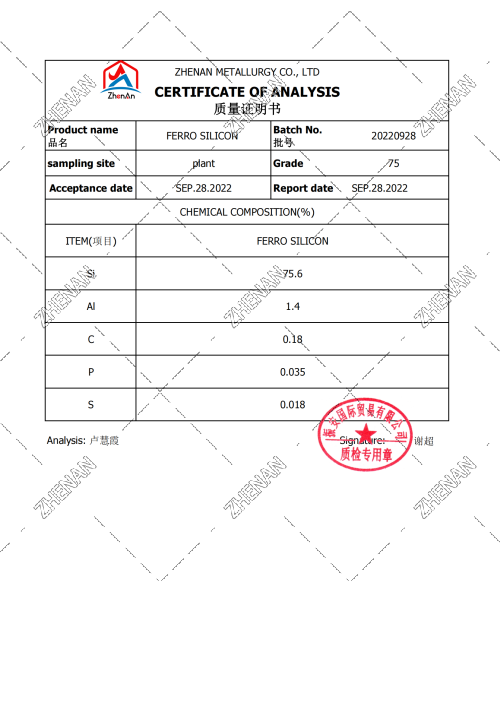
Iron Silicon Alloy With 75 Silicon Silver Grey Powder For High Strength Alloy Steel Making

🏭 Why Choose ZhenAn?


We understand the common pain points in current product procurement:
•High local cost and unstable supply
•Long lead times affecting project schedules
•Incomplete product ranges
•Slow communication and lack of follow-up


We Help Solve These Problems With:
✅ Large stock ready for fast delivery
✅ One-stop sourcing for Ferro Silicon, silicon metal, Silicon Metal Powder , and more
✅ Strict quality control with international standards
✅ Experienced sales team with fast response and clear communication

We'd love to learn more about your needs and offer you competitive prices and efficient service.
 

one-stop solution

professional team

high quality

Q: Ferrosilicon in the production of nodular cast iron?
A: Acts as inoculant, promotes graphite spheroidization.

Q: Use of low-silicon ferrosilicon (FeSi15) in welding electrodes?
A: Provides alloying without excessive Si, stabilizes arc.

Q: Chemical composition of ferrosilicon (Si, Fe, impurities)?
A: Si (15–90%), Fe balance, small Al, Ca, C, P, S.

Q: Melting point and density of ferrosilicon?
A: ~1200–1300 °C; density ~3.5–5.0 g/cm³ (grade dependent).

Q: Silicon content range in different ferrosilicon grades?
A: Typically 15%, 45%, 65%, 75%, up to 90%.

Q: Effect of silicon content on ferrosilicon properties?
A: Higher Si lowers melting point, increases brittleness.

Q: ASTM/ISO standard for ferrosilicon?
A: ASTM A1006 (chemical specs); ISO 5448 also applicable.

Q: Quality specifications for ferrosilicon used in construction steel?
A: High Si purity, low Al/Ca/P/S, consistent composition.

Q: Testing methods for silicon content in ferrosilicon?
A: Gravimetric, XRF, ICP-OES analysis.

Q: Acceptable impurity limits (e.g., Al, Ca, P) in ferrosilicon?
A: Low ppm–pct levels; varies by grade and application.

Q: Energy consumption in ferrosilicon production?
A: Very high; ~4000–6000 kWh/ton due to high smelting temps.