What Are The Advantages Of FeSi70: Lower Cost And Sufficient Deoxidation For Common Steel?

Dec 12, 2025

Leave a message


What Are the Advantages of FeSi70: Lower Cost and Sufficient Deoxidation for Common Steel?

Why FeSi70 Is a Practical Choice for Everyday Steelmaking
FeSi70 (≈ 68–72 % Si) offers a balance between cost and performance, making it attractive for common steel grades​ where ultra‑high Si content is unnecessary.
Advantage
Explanation
Lower purchase price per ton
Cheaper than FeSi75 or FeSi90 due to lower Si concentration and reduced raw material/energy input.
Sufficient deoxidation power
Si content is high enough to effectively remove dissolved oxygen in carbon steel, low‑alloy steel, and general foundry iron.
Dual function
Provides both deoxidation and alloying in one addition, saving process steps and energy.
Lower Fe dilution
Compared to lower‑Si grades (FeSi65), FeSi70 adds more Si per unit weight, reducing total Fe introduced into melt.
Manageable slag volume
Less SiO₂ formed per unit of Si added compared to higher Si alloys for the same final Si level, easing slag handling.
Flexible availability
Widely stocked in regions where higher Si grades may be scarce or over‑spec for common steel needs.
Easier dosage control
Moderate Si content allows precise adjustment for typical steel Si targets (0.15–0.30 %) without overshoot risk.
Practical Benefit:
For rebar, structural steel, and simple carbon steel, FeSi70 delivers the required cleanliness and strength enhancement at lower total alloy cost​ than higher Si ferroalloys, while avoiding the brittleness and dust issues of FeSi90.


What Are the Limitations of FeSi70 in High-Strength Steel (e.g., Insufficient Si for Precipitation Strengthening)?

Why FeSi70 Is Not Ideal for Advanced High-Strength Steels
High‑strength steels (e.g., AHSS, dual‑phase, TRIP, martensitic) often rely on multi‑element alloying​ and precipitation strengthening​ to achieve strength‑toughness combinations. FeSi70 has notable limitations here:
Limitation
Explanation
Insufficient Si for target levels
Some high‑strength grades require Si > 1.5 % for solid solution strengthening and inhibiting cementite formation; FeSi70 max ~72 % Si means large additions → excessive Fe dilution.
Excess iron addition
To reach high final Si, large FeSi70 masses introduce too much Fe, altering hardenability and alloy balance.
No contribution to precipitation strengthening
Si alone doesn't form strengthening precipitates (unlike Nb, V, Ti, Mo); relying solely on FeSi70 limits strength potential.
Impurity pickup
FeSi70 contains Al (≤ 2 %) and other impurities that may interfere with advanced microalloying reactions.
Slag volume
Large SiO₂ generation complicates slag management and refractory wear in advanced steel processes.
Precision control difficulty
Small errors in FeSi70 addition cause larger deviations in final Si in high‑Si steels, making tight control harder.
Alternative preference
High‑strength steels usually use pure silicon metal​ or FeSi90/FeSi95​ for efficient Si addition with minimal Fe, plus other microalloying elements.
Conclusion:
FeSi70 is unsuitable​ as the primary Si source for high‑strength steel requiring > 1.0–1.5 % Si and complex precipitation strengthening; higher Si alloys or pure Si are preferred.


What Is the Effect of FeSi70 Addition on Steel Weldability?

Influence on Weldability in Common Steel Grades
The effect of FeSi70 on weldability​ depends on final Si content​ in the steel and welding process.

Primary Effects

Solid solution strengthening​ from Si increases strength but can reduce ductility in heat‑affected zone (HAZ) if Si is too high.
Moderate Si (0.15–0.30 %)​ from FeSi70 generally has neutral to slightly positive​ effect on weldability:
Improves HAZ toughness in some low‑carbon steels.
Reduces risk of hot cracking compared to very high Si levels.
Excessive Si (> 0.5 %)​ can:
Increase hardenability of HAZ → higher risk of cold cracking in restrained joints.
Reduce notch toughness in weld metal.
In some cases, promote ferrite formation that improves weldability, but balance is critical.

Welding Process Considerations

Process
Effect of FeSi70‑induced Si
Comments
SMAW / GMAW
Moderate Si usually beneficial for bead shape and penetration
Avoid excessive Si to prevent hardening
SAW
Si improves slag fluidity but high Si can cause porosity
Control Si level
Laser / EB welding
Low to moderate Si helps with fluidity, but high Si may increase spatter
Precise Si control needed
Guideline:
For common steel grades​ made with FeSi70, keeping final Si ≤ 0.35 %​ generally maintains good weldability. In high‑Si steels, preheat and interpass temperature control become more critical to avoid cracking.


Summary Table

Question
Answer
Advantages of FeSi70: lower cost and sufficient deoxidation for common steel
Lower cost per ton, effective deoxidation, dual function, lower Fe dilution, manageable slag, flexible availability, precise control for typical Si targets.
Limitations of FeSi70 in high‑strength steel
Insufficient Si for high targets, excess Fe dilution, no precipitation strengthening, impurity risk, large slag volume, poor precision control.
Effect of FeSi70 addition on steel weldability
Moderate Si (0.15–0.30 %) generally neutral/slightly positive; excessive Si (> 0.5 %) can reduce HAZ toughness and increase cracking risk; control Si ≤ 0.35 % for good weldability.


Ferrosilicon FAQ

China Metallurgy Application Ferro Silicon / Ferrosilicon for Pure Ferro Silicon 75% for Steel and Iron Industry at Competitive Prices

Ferro Silicon 75
Ferro Silicon 72
Ferro Silicon 70
Ferro Silicon 75

Q: What is ferrosilicon?
A: An iron-silicon alloy used mainly in steelmaking and foundry.


Q: Ferrosilicon definition and main components?
A: Iron–silicon alloy; mainly Si (15–90%) and Fe, with minor impurities.


Q: Difference between ferrosilicon and silicon metal?
A: Ferrosilicon contains iron; silicon metal is nearly pure silicon.


Q: Common grades of ferrosilicon (e.g., FeSi75, FeSi45)?
A: Named by Si%; FeSi75 ≈75% Si, FeSi45 ≈45% Si.


Q: How is ferrosilicon produced?
A: Smelting quartz (SiO₂) with coke and iron in an electric arc furnace.


Q: Raw materials for ferrosilicon manufacturing (quartz, coke, steel scrap)?
A: Quartz, carbon reductant (coke/coal), iron source (scrap/ore).


Q: Electric arc furnace process for ferrosilicon smelting?
A: Charge materials, apply high-temp arc, reduce SiO₂ to Si, absorb into iron.


Q: Factors affecting silicon recovery rate in ferrosilicon production?
A: Furnace temp, raw material purity, power input, slag control.


Visit https://www.metal-alloy.com/ to learn more about the product. If you would like to learn more about the product price or are interested in purchasing, please email market@zanewmetal.com. We will get back to you as soon as we see your message.
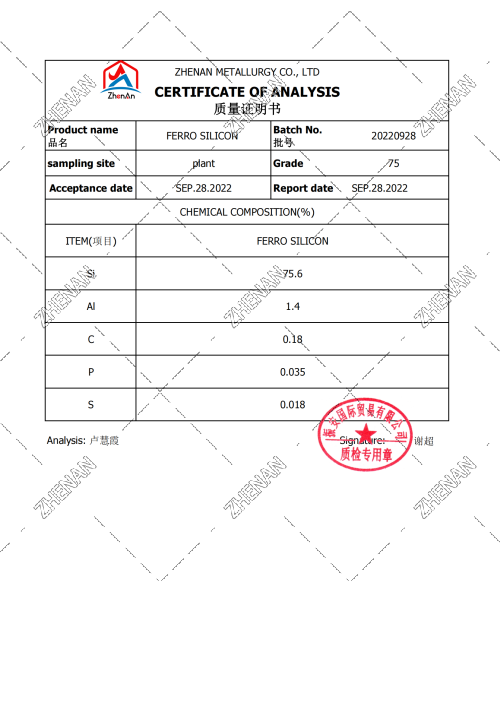
 

Get a Quote Today


Iron Silicon Alloy With 75 Silicon Silver Grey Powder For High Strength Alloy Steel Making

🏭 Why Choose ZhenAn?


We understand the common pain points in Ferro Silicon sourcing today:
•High local cost and unstable supply
•Long lead times affecting project schedules
•Incomplete product ranges
•Slow communication and lack of follow-up


We Help Solve These Problems With:
✅ Large stock ready for fast delivery
✅ One-stop sourcing for Ferro Silicon, silicon metal, Silicon Metal Powder , and more
✅ Strict quality control with international standards
✅ Experienced sales team with fast response and clear communication

We'd love to learn more about your needs and offer you competitive prices and efficient service.
 

one-stop solution

professional team

high quality