


What is the price of silicon carbide today?
| Summary of China's Silicon Carbide Market as of April 10, 2026 | |||
| Unit: Yuan/ton, cash price including tax | |||
| Introduction: The prices below are for reference only. Manufacturers can set prices according to their own actual situation. | |||
| product | Grade (block material) | Today's price | Note (Northwest Region) |
| silicon carbide | 98 | 5800-5900 | -- |
| 88 | 4800-4900 | -- | |
| 1) 98# silicon carbide | |||
| area | Today's price | rise and fall | |
| Gansu | 5800-5900 | -- | |
| Ningxia | 5800-5900 | -- | |
| 2) 88# Silicon Carbide | |||
| area | Today's price | rise and fall | |
| Gansu | 4800-4900 | -- | |
| Ningxia | 4800-4900 | -- | |
What are the common grades of silicon carbide?
The common grades of silicon carbide (SiC) below 85% purity are typically SiC 80%, SiC 75%, and SiC 70%, which are widely used in cost-sensitive applications such as steelmaking, casting, and refractory materials. These lower-purity grades offer a practical balance between performance and price, making them ideal for bulk industrial consumption where ultra-high purity is not required.
What are the specifications of low-grade silicon carbide (SiC 70%–80%)?
For procurement, buyers focus not only on SiC content but also on particle size, impurities, and application suitability. Below is a typical specification range for industrial-grade silicon carbide under 85%:
Chemical Composition (Typical Range):
SiC: 70% / 75% / 80%
SiO₂: 5–15%
Fe₂O₃: 2–8%
C (Free Carbon): 3–10%
Moisture: ≤1%
Particle Size (Customizable):
Lump: 10–50 mm, 10–100 mm
Granular: 1–10 mm, 0–10 mm
Powder: 0–1 mm, 200 mesh, 325 mesh
Packaging:
1 MT jumbo bags or 25 kg small bags (custom packaging supported)
These specifications can be adjusted based on specific metallurgical or refractory requirements, which is critical for buyers aiming at stable furnace performance and predictable consumption rates.
Why choose SiC 70%–80% for industrial applications?
Low-grade silicon carbide is primarily used where cost control and bulk usage are more important than ultra-high purity.
In steelmaking, SiC 75% and 80% are commonly used as deoxidizers and recarburizers, partially replacing ferrosilicon or carbon additives. Compared with higher-grade SiC (90%+), these grades significantly reduce raw material costs while still improving molten steel quality and reducing oxygen content.
In foundry applications, SiC 70%–75% is often used to adjust carbon and silicon simultaneously. This helps improve casting fluidity and reduce defects such as porosity, especially in gray iron and ductile iron production.
In refractory materials, lower-grade SiC is widely used in kiln furniture, castables, and lining materials, where thermal shock resistance and wear resistance are required, but ultra-high purity is unnecessary.
How do SiC 70%, 75%, and 80% compare with higher grades?
The key difference between low-grade (70%–80%) and high-grade silicon carbide (88%, 90%, 98%) lies in purity, performance, and cost structure.
Compared with SiC 90% or 98%:
Higher grades provide better oxidation resistance, higher thermal conductivity, and cleaner chemical performance. They are used in ceramics, semiconductor, and precision applications. However, their price is significantly higher.
Compared with SiC 88%–90% (mainstream mid-grade):
SiC 80% offers a more economical alternative for steel mills that do not require strict impurity control. The trade-off is slightly lower efficiency and higher consumption per ton.
Within low-grade range (70 vs 75 vs 80):
SiC 80% provides better performance and lower impurity levels, making it the most widely accepted among low grades. SiC 75% balances cost and usability, while SiC 70% is mainly used in highly cost-sensitive or less demanding environments.
In practice, many buyers optimize procurement by mixing different grades to achieve the best cost-performance ratio.
What factors should buyers consider when sourcing low-grade SiC?
Professional procurement decisions are based on multiple technical and commercial factors.
First, the application scenario determines the required SiC content. Steelmaking typically prefers 75%–80%, while refractories may accept 70%.
Second, impurity control is critical. Excessive Fe₂O₃ or SiO₂ can negatively affect furnace performance and final product quality.
Third, particle size distribution impacts reaction speed and consistency. Uniform sizing ensures stable performance in industrial processes.
Finally, supplier consistency and logistics capability are key. Stable chemical composition across batches directly affects production efficiency and cost control.
Summary
Silicon carbide grades below 85%-especially SiC 80%, 75%, and 70%-are widely used in steelmaking, casting, and refractory industries due to their cost-effectiveness and sufficient performance. While they do not match the purity of higher-grade SiC, they provide a highly economical solution for bulk industrial applications where cost control is critical.
FAQ – Common Procurement Questions About Low-Grade Silicon Carbide
1. What is the main use of SiC 70%–80%?
These grades are mainly used in steelmaking (deoxidizer), casting (carbon & silicon additive), and refractory materials. They are ideal for bulk consumption with cost constraints.
2. Can SiC 75% replace ferrosilicon?
Partially, yes. SiC can act as both a silicon and carbon source, reducing the need for separate additives. However, exact substitution depends on process requirements and should be tested in production.
3. Which is better: SiC 75% or 80%?
SiC 80% offers better performance and lower impurities, making it more stable in steelmaking. SiC 75% is more cost-effective and widely used in general applications.
4. What particle size should I choose?
For steelmaking, 1–10 mm or 10–50 mm is common. For refractory or powder metallurgy, finer sizes such as 0–1 mm or 200 mesh are preferred.
5. How do impurities affect performance?
High levels of Fe₂O₃ or SiO₂ can reduce efficiency and introduce unwanted elements into the final product. Consistent quality control is essential.
6. How to ensure stable supply quality?
Choose suppliers with strict quality control systems, batch testing, and export experience. Request COA (Certificate of Analysis) and consider third-party inspection.
Get Reliable Low-Grade Silicon Carbide Supply
Looking for stable supply of SiC 70% / 75% / 80% with competitive pricing and consistent quality? We provide factory-direct solutions tailored for steel plants, foundries, and refractory producers.
Contact us for quotation and samples:
Email: market@zanewmetal.com
WhatsApp: +86 15518824805
Fast quotation within 24 hours
Custom size & specification available
Long-term stable supply for bulk orders
Trusted Silicon Carbide Supplier – Quality · Experience · Factory Strength
All silicon carbide products are manufactured under strict ISO9001 quality management systems and supported by third-party inspection. COA, SDS, and REACH documents are available to ensure smooth international trade compliance.
24-hour quotation response with experienced technical support team to help select the correct SiC grade (80/75/70) based on specific furnace and metallurgical requirements.
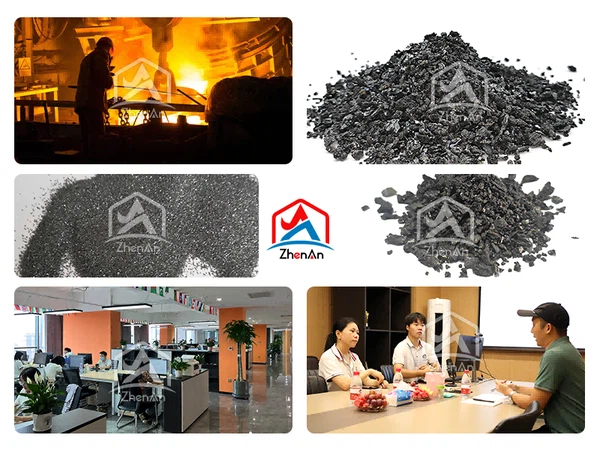
01
30+ Years of Experience
With over three decades of industry expertise in ferroalloys and abrasives, ZhenAn has strong know-how in producing and supplying low-grade silicon carbide (below 85%), ensuring stable performance and cost efficiency for industrial users.
02
Stable Quality for 70–80% SiC Grades
Specialized in SiC 80%, 75%, 70% and similar grades, with strict control of SiC content, free carbon, Fe₂O₃, and particle size distribution to ensure consistent behavior in metallurgical applications.
03
Reliable Supply & Cost Advantage
Strong production capacity and optimized sourcing system allow stable bulk supply of low-grade silicon carbide, helping customers reduce raw material cost while maintaining process stability.
04
Flexible Specifications & OEM Service
Available in multiple sizes and grades for steelmaking, casting, and refractory applications. Custom packaging, particle grading, and private labeling are supported for global distributors.