


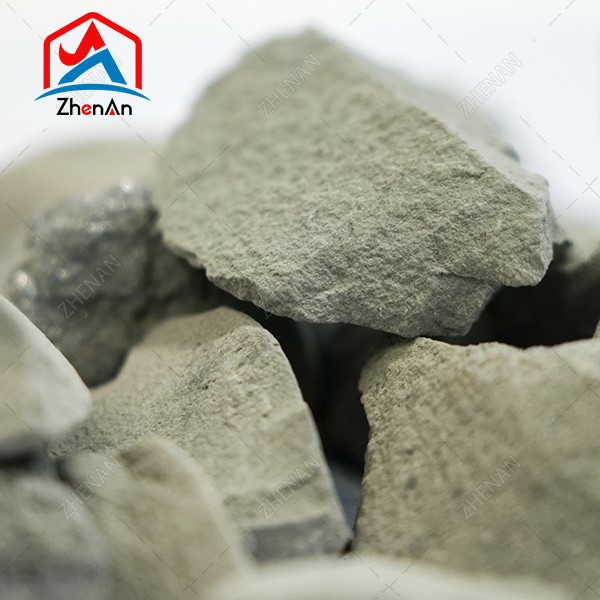
① What is ferrosilicon nitride and why is it relevant to taphole clay systems?
Ferrosilicon nitride (FeSiN) is a nitrogen-bearing metallurgical additive composed of iron, silicon, and stable nitride phases (mainly Si₃N₄). In modern blast furnace refractory engineering, it is widely classified as a refractory material additive used to improve structural integrity in extreme thermal and mechanical environments.
In India's continuous tapping operations, where furnace productivity is increasing and tapping frequency is higher, taphole clay cracking issues (refractory cracking issue) have become more frequent due to unstable thermal cycling and aggressive slag conditions. FeSiN is increasingly used to stabilize the internal bonding structure of clay, improving resistance against cracking, erosion, and deformation.
② Why does taphole clay cracking occur in continuous tapping systems and how does FeSiN help?
In continuous tapping operations, taphole clay is exposed to repeated cycles of heating, cooling, and high-pressure molten iron flow. These conditions often lead to poor thermal shock resistance (refractory thermal shock failure) and unstable refractory bonding, which are the primary causes of cracking.
Cracking typically starts when internal stress exceeds the bonding strength of the clay matrix. Once microcracks form, they propagate rapidly due to slag penetration and mechanical shear from molten metal flow.
FeSiN helps mitigate this failure mechanism by forming stable nitride bonding phases during operation. These phases improve structural cohesion and reduce stress concentration, directly addressing low taphole clay durability and inconsistent refractory bonding issues commonly observed in Indian blast furnace systems.
③ Technical specification of FeSiN for refractory applications
| Parameter | Specification |
|---|---|
| Product | Ferrosilicon Nitride (FeSiN) |
| Nitrogen Content | 20% – 30% (controlled / stable grade) |
| Key Phase | Si₃N₄ + Fe-Si matrix |
| Product Forms | FeSiN powder / granular FeSiN |
| Particle Size | 0–1 mm / 1–3 mm / 200 mesh powder |
| Density | 2.4 – 3.2 g/cm³ |
| Function | nitride bonding additive / refractory material additive |
| Purity Level | low impurity silicon nitride alloy |
| Stability Focus | consistent nitrogen level / batch control |
④ How does ferrosilicon nitride reduce cracking in taphole clay systems?
In taphole clay used for continuous tapping, cracking is strongly linked to thermal stress accumulation and weak bonding structures. When temperature fluctuates rapidly, materials with insufficient hot strength fail to maintain structural integrity, resulting in crack initiation.
FeSiN improves performance by generating in-situ Si₃N₄ networks that act as reinforcement bridges within the clay matrix. These networks enhance resistance to thermal expansion mismatch, reducing internal stress during tapping and plugging cycles.
At the same time, FeSiN reduces the impact of slag penetration problem and slag attack on refractories, which are key contributors to crack propagation. By limiting slag infiltration, the internal structure remains denser and less prone to mechanical failure.
In high-load Indian blast furnace systems, this directly translates into reduced fast runner material wear and improved operational stability in taphole regions.
⑤ FeSiN grade comparison for taphole clay performance
Stable nitrogen FeSiN vs batch variation FeSiN
Stable nitrogen FeSiN provides consistent bonding phase formation, reducing batch quality variation (inconsistent FeSiN quality). In contrast, variable nitrogen content leads to uneven structural reinforcement and higher cracking probability.
FeSiN powder vs granular FeSiN
FeSiN powder (200 mesh) ensures uniform dispersion and faster reaction in fine clay systems. Granular FeSiN is preferred in high-load applications where gradual reaction improves long-term structural stability.
High-nitrogen FeSiN vs conventional FeSiN
High-nitrogen FeSiN improves bonding strength and reduces unstable nitrogen content (inconsistent nitrogen level) issues, which are critical in continuous tapping environments.
⑥ How is FeSiN supplied for industrial taphole clay applications?
FeSiN is supplied in both powder and granular forms depending on refractory system design. Powder grades are typically used in fine-matrix taphole clay formulations, while granular materials are used in heavier-duty furnace zones.
Packaging is done in moisture-proof 1-ton jumbo bags with inner liners to prevent oxidation and maintain nitrogen stability during transport and storage. This ensures consistent performance even under long-distance logistics conditions.
As a FeSiN manufacturer and ferrosilicon nitride supplier, ZhenAn provides controlled-grade materials designed for high-demand Indian blast furnace environments where high refractory cost pressure requires longer service life and improved efficiency.
⑦ FAQ: Can ferrosilicon nitride reduce taphole clay cracking in continuous tapping?
How does FeSiN help reduce cracking in taphole clay systems?
It forms Si₃N₄ bonding structures that strengthen internal cohesion and reduce crack initiation under thermal stress.
Why is crack resistance important in continuous tapping operations?
Because cracking leads to premature failure, unstable tapping performance, and increased downtime.
Can FeSiN improve structural stability in furnace clay?
Yes, it enhances bonding strength and reduces weak interface formation inside the refractory matrix.
How does FeSiN affect thermal expansion behavior in refractories?
It stabilizes internal structure, reducing stress caused by thermal expansion mismatch.
Why do continuous tapping systems require high bonding strength materials?
Because they operate under repeated mechanical and thermal load cycles that weaken conventional clay.
How does FeSiN improve resistance to mechanical stress?
It reinforces microstructure, reducing deformation under molten iron flow pressure.
Can FeSiN reduce failure frequency in taphole applications?
Yes, by improving thermal shock resistance and bonding stability.
What role does FeSiN play in refractory toughness improvement?
It enhances fracture resistance by forming nitride-based reinforcing phases.
For technical consultation, specification support, or bulk supply of refractory-grade FeSiN:
Email: market@zanewmetal.com
WhatsApp: +86 15518824805
Visit https://www.metal-alloy.com/ to learn more about the product. If you would like to learn more about the product price or are interested in purchasing, please email market@zanewmetal.com. We will get back to you as soon as we see your message.