



What Are the Common Grades of Electrolytic Manganese Flakes?

Understanding Electrolytic Manganese Flake Grades for Industrial Applications
Electrolytic Manganese Flakes (EMM) are high-purity manganese metal products produced through the electrolytic refining of manganese sulfate solution. Unlike ferromanganese alloys, electrolytic manganese flakes contain a much higher manganese content, typically ranging from 99.7% to 99.9% Mn, with strictly controlled levels of carbon, sulfur, phosphorus, iron, and other impurities.
Different grades of electrolytic manganese flakes are classified mainly according to:
Manganese content (Mn%)
Impurity limits
Application requirements
Industry standards
The most common commercial grades include:
Mn 99.7% Electrolytic Manganese Flakes
Mn 99.8% Electrolytic Manganese Flakes
Mn 99.9% High Purity Manganese Flakes
Choosing the correct grade depends on the customer's downstream application, such as stainless steel production, specialty alloys, aluminum alloys, welding materials, or battery-related manganese chemicals.
Main Grades of Electrolytic Manganese Flakes
1. Mn 99.7% Electrolytic Manganese Flakes (Standard Industrial Grade)
Mn 99.7% is the most widely used commercial grade of electrolytic manganese flakes. It provides a balance between purity, availability, and cost efficiency.
This grade is commonly supplied to:
Stainless steel manufacturers
Alloy steel producers
Aluminum alloy plants
Welding electrode manufacturers
General metallurgical applications
Typical chemical composition:
| Element | Typical Requirement |
|---|---|
| Mn | ≥99.7% |
| C | ≤0.04% |
| S | ≤0.05% |
| P | ≤0.005% |
| Fe | Controlled level |
| Si | Controlled level |
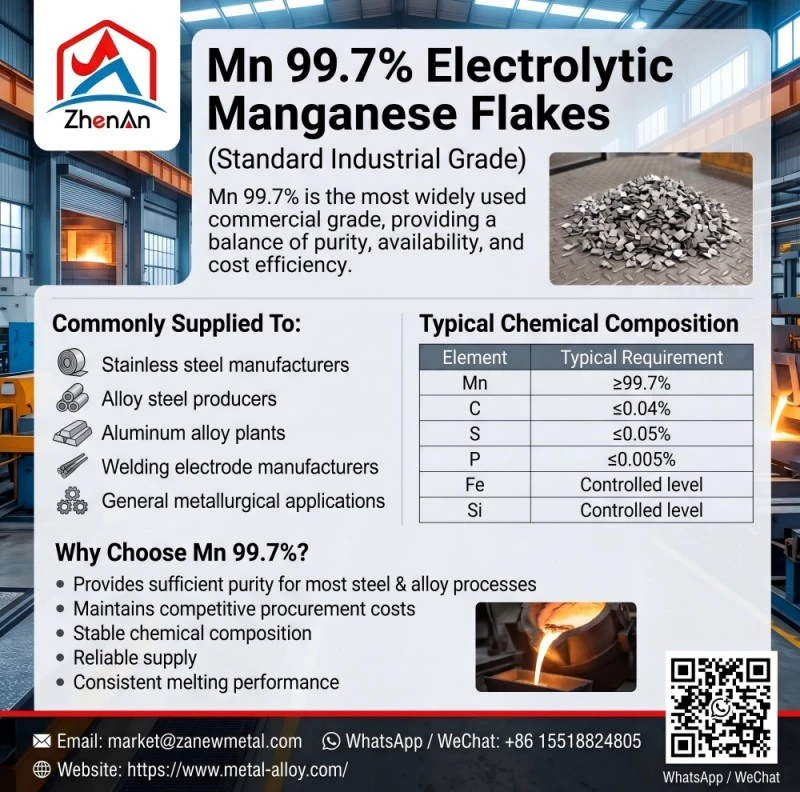
Why choose Mn 99.7%?
For most steelmaking and alloy production processes, Mn 99.7% provides sufficient manganese purity while maintaining competitive procurement costs.
It is the preferred grade for buyers who require:
Stable chemical composition
Reliable supply
Cost-effective manganese addition
Consistent melting performance
2. Mn 99.8% Electrolytic Manganese Flakes (Higher Purity Grade)
Mn 99.8% electrolytic manganese flakes offer improved impurity control compared with standard Mn 99.7% grades.
This grade is often selected when manufacturers need:
Lower impurity input
Better alloy consistency
Improved product performance
Typical applications include:
High-quality stainless steel
Special alloy production
Aerospace-related alloys
Precision metallurgical processes
The lower levels of carbon, sulfur, phosphorus, and iron help manufacturers achieve tighter control of final alloy properties.
3. Mn 99.9% High Purity Electrolytic Manganese Flakes
Mn 99.9% electrolytic manganese flakes represent the highest purity commercial category.
This grade is mainly used in applications where impurity control is extremely important.
Common applications include:
Battery material production
High-performance alloys
Electronic materials
Advanced research applications
For battery-related manganese products, high-purity manganese is often processed into manganese sulfate (MnSO₄) or other manganese compounds used in cathode material manufacturing.
Advantages of Mn 99.9% grade:
Extremely low impurity content
Higher chemical consistency
Suitable for sensitive manufacturing processes
Electrolytic Manganese Flakes Grade Comparison
| Grade | Mn Content | Purity Level | Main Applications |
|---|---|---|---|
| Mn 99.7% | ≥99.7% | Industrial Grade | Steelmaking, alloys, welding |
| Mn 99.8% | ≥99.8% | High Purity Grade | Stainless steel, specialty alloys |
| Mn 99.9% | ≥99.9% | Ultra High Purity | Battery materials, advanced alloys |
How to Select the Right Electrolytic Manganese Flake Grade?
For international buyers, selecting the correct manganese flake grade depends on several factors:

Application Requirements
Steelmaking
Most steel producers choose:
Mn 99.7% electrolytic manganese flakes
because manganese is mainly used for:
Deoxidation
Sulfur control
Alloy strengthening
Stainless Steel Production
Stainless steel manufacturers usually require:
Mn 99.7% – Mn 99.8% grades
because manganese helps improve:
Mechanical strength
Corrosion resistance
Austenitic structure stability
Battery Material Production
Battery manufacturers generally require:
Mn 99.8% – Mn 99.9% high purity grades
because impurities such as:
Iron (Fe)
Copper (Cu)
Lead (Pb)
Sulfur (S)
may affect battery material performance.
Common Packaging Options for Electrolytic Manganese Flakes
For export markets, electrolytic manganese flakes are normally supplied in:
1 MT jumbo bags
25 kg bags inside jumbo bags
Steel drums
Customized export packaging
Typical export documentation includes:
Certificate of Analysis (COA)
Packing List
Commercial Invoice
SGS inspection report (if required)
Quality Control of Electrolytic Manganese Flakes
Reliable manganese suppliers usually control quality through:

Chemical Analysis
Common testing methods include:
ICP-OES analysis
Atomic absorption spectroscopy (AAS)
Laboratory chemical analysis
Key elements tested:
Mn
C
S
P
Fe
Si
Physical Inspection
Quality inspection includes:
Flake size distribution
Surface appearance
Moisture control
Packaging condition
For international procurement, buyers should request a COA before shipment to confirm that the material meets their production requirements.
Electrolytic Manganese Flakes vs Ferromanganese: Which Grade Should Buyers Choose?
Electrolytic manganese flakes and ferromanganese serve different purposes.
| Item | Electrolytic Manganese Flakes | Ferromanganese |
|---|---|---|
| Mn Content | 99.7%–99.9% | Usually 65%–80% |
| Form | Metal flakes | Alloy lumps |
| Purity | Very high | Lower |
| Main Use | High purity manganese addition | Bulk steel alloying |
Buyers requiring precise manganese control usually prefer electrolytic manganese flakes, while large-scale steel producers may select ferromanganese for cost-effective alloying.
FAQ About Electrolytic Manganese Flake Grades
What is the most common grade of electrolytic manganese flakes?
The most common commercial grade is Mn 99.7% electrolytic manganese flakes, widely used in steelmaking, alloy production, and metallurgical applications.
What is the difference between Mn 99.7% and Mn 99.9% manganese flakes?
The main difference is impurity control. Mn 99.9% has higher manganese purity and stricter limits on elements such as iron, sulfur, and carbon, making it suitable for more sensitive applications.
Which electrolytic manganese grade is used for stainless steel?
Most stainless steel manufacturers use Mn 99.7% or Mn 99.8% electrolytic manganese flakes depending on their alloy requirements.
Which manganese flake grade is suitable for battery materials?
Battery-related applications usually require high purity manganese products, commonly Mn 99.8% or Mn 99.9%, with strict impurity specifications.
How do buyers verify electrolytic manganese flake quality?
International buyers normally verify quality through:
Certificate of Analysis (COA)
Third-party inspection
Chemical composition testing
Supplier quality documentation
Conclusion: Choosing the Right Electrolytic Manganese Flake Grade
The correct electrolytic manganese flake grade depends on the balance between purity requirements, application performance, and procurement cost.
For most metallurgical applications:
Mn 99.7% is the standard industrial choice.
Mn 99.8% is preferred for higher-quality alloys.
Mn 99.9% is selected for high-purity and battery-related applications.
Understanding these grade differences helps steel mills, alloy producers, and international buyers select manganese flakes that meet both technical requirements and production targets.
For electrolytic manganese flakes supply, technical specifications, COA documents, and export inquiries:
Email: market@zanewmetal.com
WhatsApp / WeChat: +86 15518824805