What Is High Purity Manganese?

Dec 05, 2025

Leave a message

What is the price of manganese metal flakes?


Today's European electrolytic manganese market price
Unit: US dollars/ton
product Specification Lowest price rise and fall highest price rise and fall Price Explanation
Electrolytic manganese 99.70% 2085 -- 2105 -- European market


What is the price of manganese metal flakes per kg?

Today's price of manganese metal exported from China
Unit: (USD/ton)
product Brand Quotation rise and fall Transaction price rise and fall Remark
Electrolytic Manganese 99.70% 2020-2040 -- 2020-2040 -- Tianjin Port, FOB
Manganese ingots 95# 2085-2095 -- 2065-2085 -- Tianjin Port, FOB
Manganese ingots 97# 2095-2105 -- 2095 -- Tianjin Port, FOB


1. What Are the Disadvantages of Manganese in Steel?

Aspect
Details
General Role
Manganese is widely added to steel as an alloying and deoxidizing element, but excessive or poorly controlled use brings drawbacks.
Impact Dependence
Effects vary with Mn content, steel grade, and heat-treatment process.

Key Disadvantages

Excess Hardenability
High Mn (>1.5–2%) increases hardenability significantly, which can cause quench cracking​ in thick sections if cooling rates are not properly managed.
Brittleness Risks
In very high concentrations (above ~13%), Mn can form brittle intermetallic phases or promote retained austenite, reducing toughness.
Machinability Reduction
Elevated Mn levels can shorten tool life and increase machining forces due to higher strength and work-hardening tendency.
Segregation Issues
During solidification, Mn can segregate unevenly, creating localized compositional variations that impair mechanical uniformity.
Sulfur Interaction Pitfalls
Although Mn ties up sulfur to form MnS (less harmful than FeS), too much MnS can elongate inclusions, affecting fatigue resistance in some applications.
Cost Impact
High-Mn steels require more alloy addition, increasing raw material expenses, especially for high-purity or electrolytic Mn.

Mitigation Strategies

Control Mn within recommended ranges for steel grade.
Optimize heat treatment to manage phase transformations.
Balance with other alloying elements to retain machinability and toughness.
Used appropriately, manganese enhances steel; uncontrolled levels introduce processing and performance challenges.


2. What Is High Purity Manganese?

Aspect
Details
Definition
High purity manganese refers to manganese metal with extremely low impurity levels, typically ≥99.7% Mn, often reaching 99.9% for specialized uses.
Production Route
Mainly obtained via electrolysis of purified manganese sulfate solution.

Characteristics

Very low contents of Fe, Co, Ni, Pb, S, C, Si, and other tramp elements.
Uniform crystalline structure and consistent chemical composition.
Available in forms such as flakes, powder, granules, or ingots.

Applications

Battery Industry: Critical for producing high-quality manganese dioxide (MnO₂) for alkaline and lithium-ion batteries.
High-Grade Steels: Where trace impurities can alter mechanical or corrosion properties.
Electronics & Magnetics: Used in soft magnetic alloys and precision components needing stable electrical performance.
Aerospace & Defense Alloys: Ensures reliability in extreme-condition materials.

Advantages Over Lower Purity Forms

Minimizes contamination risks in sensitive applications.
Provides predictable metallurgical response and performance consistency.
High purity manganese is essential where even minor impurities could compromise product quality or functionality.


3. What Is Considered High Grade Manganese?

Aspect
Details
Definition
"High grade manganese" describes ore or manganese products with high Mn content​ and favorable impurity profile for efficient processing and end-use performance.
Ore vs Product
Can refer to mined ore or refined products like manganese flakes, EMM, or ferroalloys.

High Grade Ore

Mn content: Typically ≥44% Mn; metallurgical grade ores often 48–50% Mn.
Low levels of harmful impurities (phosphorus, silica, iron) improve smelting efficiency.
Examples: Carbonate ores (rhodochrosite) and certain oxide ores (pyrolusite) with high Mn:Fe ratio.

High Grade Products

Manganese Flakes: ≥96–98% Mn.
Electrolytic Manganese Metal: ≥99.7% Mn.
Low-Impurity Ferroalloys: Controlled levels of C, Si, P for specific steelmaking needs.

Benefits

Reduces energy consumption during smelting or electrolysis.
Improves yield and lowers production costs.
Meets stringent specs for high-performance steel, batteries, and chemicals.
High grade manganese, whether ore or product, commands premium pricing due to superior processing efficiency and end-product quality.


4. What Is an Electrolytic Manganese Metal?

Aspect
Details
Definition
Electrolytic Manganese Metal (EMM) is high-purity manganese (>99.7%) produced by electrolyzing a purified manganese sulfate solution.
Origin
Developed to overcome limitations of carbothermic reduction, which yields lower-purity metal.

Production Steps

Leaching​ – Manganese ore is converted to MnSO₄ solution by acid treatment.
Purification​ – Removal of Fe, Co, Ni, Pb, etc., via precipitation/filtration.
Electrolysis​ – Mn²⁺ ions deposit as metallic Mn on cathodes; anodes are lead-alloy.
Stripping & Finishing​ – Metal is stripped, washed, dried, and may be flaked or melted.

Properties

Exceptional chemical purity.
Good electrical conductivity and moderate ductility.
Corrosion resistant in mildly acidic environments.

Applications

Premium steel and alloy production.
Manufacturing of battery-grade manganese dioxide.
Additive in aluminum/copper alloys for enhanced properties.
Electronics and powder metallurgy requiring minimal contamination.

EMM is the preferred manganese form when high purity and consistency are critical to performance.


Visit https://www.metal-alloy.com/ to learn more about the product. If you would like to learn more about the product price or are interested in purchasing, please email market@zanewmetal.com. We will get back to you as soon as we see your message.
 

Get a Quote Today


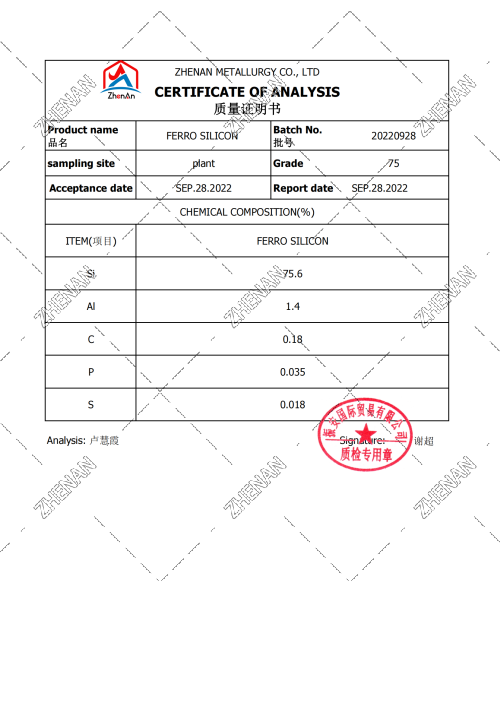
Iron Silicon Alloy With 75 Silicon Silver Grey Powder For High Strength Alloy Steel Making

🏭 Why Choose ZhenAn?


ZhenAn is located in Anyang City, Henan Province, China, with 30 years of production experience, capable of manufacturing high-quality products per customer requirements.
ZhenAn has product experts, and the chemical composition, particle size, and packaging of products can be customized as per customer needs.
Each product has an annual production capacity of 60,000 tons, ensuring a stable supply and timely delivery.
Strict quality control, with third-party inspections such as SGS and BV accepted.
We hold independent import and export qualifications.
Strict Quality Control
As a trustworthy supplier, Anyang ZhenAn ensures quality control, inspection, and technical services. We have a comprehensive quality control process throughout production, including:

 Chemical analysis of raw materials.
 Chemical analysis of molten material.
 Particle size distribution tests and other physical assessments.
 Chemical analysis before shipment.
All ferroalloy products are inspected by authoritative institutions and manufactured according to customer standards. We also accept third-party inspections at any time.


Why Choose Us?
• Best customer experience.
• Flexibility to meet various customer needs.
• High-quality expertise ensuring reliability.
• Guaranteed customer confidence.
• Competitive pricing.

one-stop solution

professional team

high quality