What Raw Materials Are Needed For The Production Of Electrolytic Manganese Sheets?

Dec 16, 2025

Leave a message


1. What Raw Materials Are Needed for the Production of Electrolytic Manganese Sheets?

Electrolytic manganese sheets (commonly called electrolytic manganese flake) are produced by the electrowinning​ of high‑purity manganese from a purified manganese sulfate solution. The process relies on specific raw materials to ensure high Mn recovery, minimal impurities, and consistent flake morphology.

Essential Raw Materials

Manganese Ore
Type: Typically pyrolusite(MnO₂) or rhodochrosite(MnCO₃).
Function: Primary source of manganese. Pyrolusite is most common due to high Mn content (~63–69 % Mn).
Requirement: Low levels of harmful impurities (e.g., arsenic, phosphorus) to simplify downstream purification.
Sulfuric Acid (H₂SO₄)
Function: Used in the leaching stage to convert manganese oxides or carbonates into soluble manganese sulfate (MnSO₄).
Concentration: Typically 20–30 % for initial leaching; higher concentrations may be used in purification steps.
Purification Chemicals
Lime (CaO) / Ca(OH)₂: Raises pH to precipitate iron as Fe(OH)₃.
Sodium sulfide (Na₂S) or ammonium sulfide ((NH₄)₂S): Precipitates heavy metals (Co, Ni, Pb, Zn) as insoluble sulfides.
Oxidizing agents (e.g., MnO₂, ozone): Aid in removing organic and certain metal impurities.
Activated carbon: Adsorbs organic contaminants during solution clarification.
Water (Deionized or Demineralized)
Function: Used for leaching, washing, electrolyte makeup, and final flake washing. Must be low in dissolved ions to avoid contaminating the electrolyte.
Electrolyte Additives
Selenium dioxide (SeO₂)​ or boron compounds: Small quantities act as grain refiners to control flake crystal size and morphology.
Antimicrobial agents: Sometimes added to prevent microbial growth in stored solutions.
Anode and Cathode Materials
Anodes: Lead‑alloy grids (Pb‑Ag, Pb‑Ca‑Sn) resistant to sulfuric acid.
Cathodes: Stainless steel or titanium sheets where manganese deposits as flakes.

Raw Materials Summary Table

Material
Purpose
Key Specification
Manganese ore
Mn source
≥ 45 % Mn, low As/P/alkalis
Sulfuric acid
Leaching agent
20–30 % H₂SO₄, high purity
Lime / Ca(OH)₂
Iron precipitation
High purity, fine powder
Sodium/ammonium sulfide
Heavy metal removal
Low impurity content
Deionized water
Process solvent
Low conductivity (< 1 µS/cm)
SeO₂ / boron additives
Crystal morphology control
ppm-level dosing
Lead‑alloy anodes
Conduct electricity, resist corrosion
Pb‑Ag or Pb‑Ca‑Sn alloys
Stainless steel cathodes
Mn deposition substrate
High corrosion resistance in H₂SO₄


2. What Are the Key Parameters of the Electrolytic Manganese Cell?

The electrolytic manganese cell​ is the core reactor where metallic manganese is deposited onto cathodes from purified MnSO₄ solution. Controlling key parameters ensures high current efficiency, high purity flakes, and stable operation.

Key Operational Parameters

Cell Voltage
Typical Range: 4.0–5.5 V (DC).
Effect: Determines energy consumption and deposition rate; too low slows deposition, too high increases side reactions (hydrogen evolution, oxidation).
Current Density
Typical Range: 200–500 A/m² (cathode surface).
Effect: Higher current density increases production rate but may reduce current efficiency and cause rough, powdery deposits instead of smooth flakes.
Electrolyte Temperature
Typical Range: 90–95 °C.
Effect: Higher temperature improves Mn²⁺ diffusion and conductivity but accelerates anode corrosion and side reactions if uncontrolled.
Electrolyte Composition
MnSO₄ Concentration: 35–45 g/L (optimizes conductivity and deposition kinetics).
H₂SO₄ Concentration: 10–20 g/L (maintains acidity to prevent Mn(OH)₂ precipitation).
Impurity Levels: Fe < 0.5 mg/L, Co/Ni/Pb < 0.1 mg/L (prevents contamination of flakes).
pH of Electrolyte
Range: 3.5–4.5 (slightly acidic).
Effect: Prevents hydroxide precipitation of Mn while allowing high Mn²⁺ solubility.
Electrode Gap
Typical: 40–80 mm.
Effect: Narrower gaps reduce voltage drop but increase risk of short circuits; wider gaps lower current density uniformity.
Deposition Time
Typical: 24–72 hours per batch.
Effect: Longer times yield thicker flakes but risk reduced purity due to impurity codeposition.

Key Parameters Table

Parameter
Typical Range
Impact on Process
Cell voltage
4.0–5.5 V DC
Energy use, deposition rate, side reactions
Current density
200–500 A/m²
Productivity vs. flake quality
Temperature
90–95 °C
Mn²⁺ diffusion, conductivity, anode corrosion
MnSO₄ concentration
35–45 g/L
Deposition kinetics, electrolyte conductivity
H₂SO₄ concentration
10–20 g/L
Acidity control, prevents Mn(OH)₂ formation
pH
3.5–4.5
Mn²⁺ solubility, impurity precipitation
Electrode gap
40–80 mm
Voltage drop, current uniformity
Deposition time
24–72 h
Flake thickness, productivity


3. What Are the Common Challenges in the Production of Electrolytic Manganese Sheets?

Producing high‑quality electrolytic manganese sheets faces several technical and operational challenges, arising from raw material variability, electrochemical control, and downstream handling.

Major Challenges & Mitigation

Impurity Control
Problem: Trace metals (Fe, Co, Ni, Pb) cause poor flake morphology and lower purity (< 99.7 %).
Mitigation: Multi-stage purification (precipitation, sulfide removal, filtration) and regular solution analysis.
Current Efficiency Loss
Problem: Competing hydrogen evolution at cathode lowers Mn recovery (typical efficiency 85–92 %).
Mitigation: Optimize current density, electrolyte acidity, and temperature; use additives to suppress H₂ evolution.
Flake Morphology Defects
Problem: Rough, powdery, or dendritic overgrowth instead of smooth sheets.
Mitigation: Control SeO₂ or boron addition, maintain uniform current distribution, and avoid excessive current density.
Anode Corrosion & Sludge Formation
Problem: Lead‑alloy anodes corrode, forming sludge that contaminates electrolyte.
Mitigation: Regular anode inspection/replacement; control electrolyte chloride levels.
Energy Consumption
Problem: High electricity demand (~13,000–15,000 kWh/tonne Mn) increases cost.
Mitigation: Optimize cell voltage, current density, and heat recovery from exothermic steps.
Environmental & Safety Issues
Problem: Acidic wastewater, sulfur emissions, and manganese dust hazards.
Mitigation: Closed-loop water systems, scrubbers for off-gases, and dust control during handling.

Challenges Summary Table

Challenge
Cause
Potential Impact
Mitigation Strategy
Impurity control
Ore/mineral contaminants
Low purity, poor flake quality
Multi-stage purification, analytical monitoring
Current efficiency loss
Hydrogen evolution, side reactions
Lower yield, higher cost
Optimize parameters, additives
Flake morphology defects
Excessive current density, poor additives
Irregular flakes, handling issues
Control SeO₂/boron dosing, uniform current
Anode corrosion/sludge
Acid attack, chloride impurities
Electrolyte contamination
Anode maintenance, chloride control
High energy consumption
Large cell voltage, low efficiency
Increased production cost
Parameter optimization, heat recovery
Environmental/safety risks
Acid wastewater, sulfur gases, manganese dust
Regulatory penalties, worker safety
Closed-loop systems, scrubbers, dust suppression


electrolytic manganese metal flakes FAQ

Factory Supply 99.7% Mn Manganese Metal Flakes Electrolytic Manganese Pieces Manganese Block

997 Electrolytic Manganese Metal Flakes Increases The Hardness of The Composite Metal Material for Steelmaking
997 Electrolytic Manganese Sheet for Optimal Metal Flake Production
999 electrolytic manganese metal flakes with whole sale price
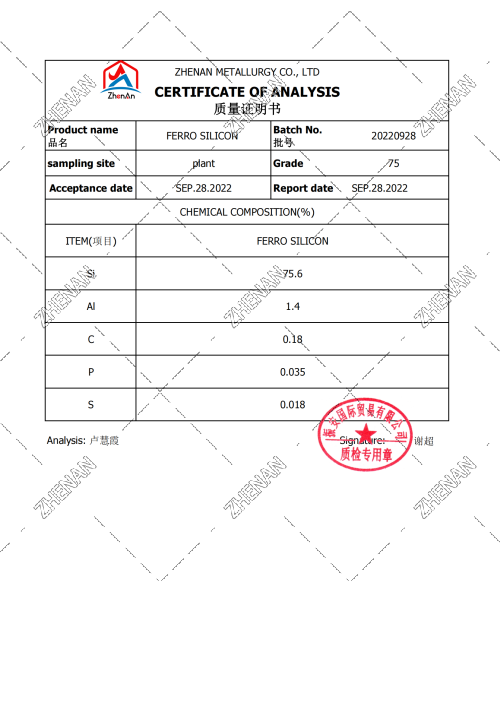
Ferro Silicon 75
Q: How to store electrolytic manganese flake properly?
A: Store in sealed, dry containers away from air and moisture to prevent oxidation and deterioration.
Q: Handling precautions for electrolytic manganese flake?
A: Avoid direct skin or mucous membrane contact; use respiratory protection to prevent dust inhalation.
Q: Packaging requirements for electrolytic manganese flake export?
A: Typically packed in steel drums or lined bags to prevent moisture ingress and contamination during transport.
Q: Safety measures during transportation of electrolytic manganese flake?
A: Secure packaging, label appropriately, protect from rain and high humidity, comply with hazardous goods regulations if required.
Q: How to prevent oxidation of electrolytic manganese flake during storage?
A: Store under inert atmosphere or with oil coating; keep containers tightly sealed and in a cool, dry place.
Q: Optimal dosage of electrolytic manganese flake in steelmaking?
A: Typically 0.2–1.5 kg per ton of steel, adjusted according to steel grade and manganese target.
Q: How to dissolve electrolytic manganese flake in molten metal?
A: Add gradually to the melt while stirring to ensure even dissolution and avoid localized cooling.
Q: Effect of electrolytic manganese flake addition on steel properties?
A: Improves strength, hardness, deoxidation, and refines grain structure; enhances hardenability.
Q: Common problems when using electrolytic manganese flake solutions?
A: Risk of oxidation before use, uneven dissolution, and unintended pickup of impurities.
Q: Compatibility of electrolytic manganese flake with other alloying elements?
A: Generally compatible with most alloying elements; care needed with strong oxidizers and highly reactive metals.
Q: Environmental impact of electrolytic manganese flake production?
A: Generates acidic wastewater and sludge; requires treatment to prevent soil and water pollution.
Q: Waste management in electrolytic manganese flake manufacturing?
A: Includes neutralization of acidic effluents, recovery of metals from sludge, and treatment of gaseous emissions.
Q: Sustainable practices in electrolytic manganese industry?
A: Use renewable energy, recycle electrolytes, minimize waste discharge, and implement closed-loop water systems.
Q: Energy consumption during electrolytic manganese flake production?
A: High; electrolysis is electricity-intensive, representing a major cost and environmental factor.


Visit https://www.metal-alloy.com/ to learn more about the product. If you would like to learn more about the product price or are interested in purchasing, please email market@zanewmetal.com. We will get back to you as soon as we see your message.
 

Get a Quote Today


Iron Silicon Alloy With 75 Silicon Silver Grey Powder For High Strength Alloy Steel Making

🏭 Why Choose ZhenAn?


We understand the common pain points in Ferro Silicon sourcing today:
•High local cost and unstable supply
•Long lead times affecting project schedules
•Incomplete product ranges
•Slow communication and lack of follow-up


We Help Solve These Problems With:
✅ Large stock ready for fast delivery
✅ One-stop sourcing for Ferro Silicon, silicon metal, Silicon Metal Powder , and more
✅ Strict quality control with international standards
✅ Experienced sales team with fast response and clear communication

We'd love to learn more about your needs and offer you competitive prices and efficient service.
 

one-stop solution

professional team

high quality