


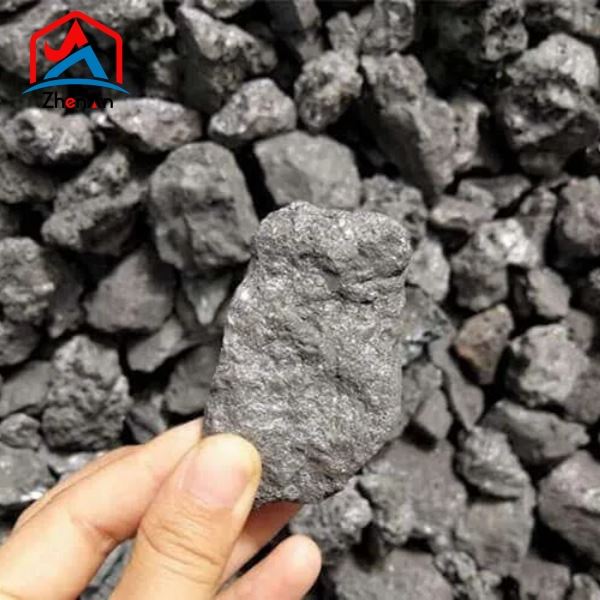


Silicon Slag refers to the by-products or wastes produced during the production of ferrosilicon, silicon alloys or other silicon-based alloys. It is mainly composed of impurities insoluble in metallic liquids during ferrosilicon smelting, and usually contains silicon (Si), oxygen (O), iron (Fe) and some other elements such as calcium, aluminum, phosphorus, sulfur and so on. The composition and properties of silica slag can vary according to the specific smelting process and raw materials used.
silicon slag main characteristics
1. Chemical composition: The main components of silica slag are silicon dioxide (SiO₂) and other oxides (such as FeO, CaO, Al₂O₃, etc.), and may also contain some harmful elements such as phosphorus, sulfur, and nitrogen, etc., and the specific composition depends on the production process and raw materials.
2. Physical properties:
- Larger hardness: Silica slag usually has higher hardness and larger specific gravity.
- Lower electrical conductivity: Compared to ferrosilicon, silica slag is less conductive because it is mostly oxides.
3. High Temperature Resistance: Since silica slag is mainly composed of high melting point substances such as silica, it has good high temperature resistance and can be stabilized in high temperature smelting process.

silicon slag main sources
Silica slag mainly comes from impurities generated in the process of **ferrosilicon production** when it reacts with other raw materials (such as quartz, coke, iron ore) in the smelting furnace. During ferrosilicon production, iron reacts with silicon to form ferrosilicon alloys, and the remaining oxide portion forms silica slag. Silicon dross may also be generated during the production of other alloys such as silicon aluminum alloys and silicon manganese alloys.
silicon slag main application areas
Although silica slag itself is a by-product, it has many potential applications in industry:
1. Building materials:
- Silica fume can be used as an admixture in concrete to improve strength, corrosion resistance and durability.
- As an active mineral admixture in cement and high-strength building materials, silica fume can improve the compressive strength and abrasion resistance of cement.
2. Steel smelting:
- Silica slag can be used as a steel dephosphorizer and slag making material in steel smelting. It helps to remove impurities (such as phosphorus and sulfur) from the steel during smelting, thus improving the quality of the steel.
- In electric arc furnace steelmaking, silica slag also helps regulate the temperature in the furnace and improve smelting efficiency.
3. Environmentally friendly materials:
- Silica slag can be used as a wastewater treatment agent to adsorb heavy metals and other pollutants.
- It can also be used as a soil conditioner to improve the fertility and structure of the soil and improve agricultural production conditions.
4. Alloy production:
- In some cases, silica slag is used as a supplementary raw material for alloys, especially in the production of silicon-aluminum alloys, silicon-manganese alloys, etc., to provide a certain amount of silicon content.
5. Electronic and electrical applications:
- Silicon dregs can be used as a raw material for electronic ceramics, especially in the production of some low conductive and high temperature resistant materials.

why choose us
ZHENAN INTERNATIOANL CO., LTD
Email: hester@zaferroalloy.com
Website: www.metal-alloy.com
Address: Huafu Office Building, Anyang, Henan province, China.
Welcome to our company or factory for a visit!
Hot Tags: silicon slag sustainable byproduct for steelmaking and construction, China silicon slag sustainable byproduct for steelmaking and construction manufacturers, suppliers, factory, Silicium Powder 325 mesh, Silicium Powder 400 mesh, High Purity Silicon Powder 200 mesh, Silicon Metal Powder 98, Metal Silicon Powder 98 8, Metal Silicon Powder 200 mesh