


How much does a ferro silicon 75 cost? What is the price of FeSi 75 ?
| Today's price of ferrosilicon exported from China | |
| Unit: US dollars/ton | |
| product | Quotation |
| Ferrosilicon 72 | 1020-1040 |
| Ferrosilicon 75 | 1100-1120 |
What is the price of Low-aluminum ferrosilicon? What is the price of ferrosilicon today?
| Today's price of special ferrosilicon in China | |||||
| Unit: Yuan/ton, natural blocks, ex-factory cash price including tax | |||||
| Mainstream prices of low-aluminum ferrosilicon in major regions of China | |||||
| Product Name | Specification | area | price | rise and fall | Remark |
| Low-aluminum ferrosilicon | Si75Al<0.1 | Qinghai | 6700-6750 | -- | Ex-factory price including tax |
| Low-aluminum ferrosilicon | Si75Al<0.5 | Qinghai | 6400-6450 | -- | Ex-factory price including tax |
| Low-aluminum ferrosilicon | Si75Al<0.1 | Inner Mongolia | 6700-6750 | -- | Ex-factory price including tax |
| Low-aluminum ferrosilicon | Si75Al<0.5 | Inner Mongolia | 6400-6450 | -- | Ex-factory price including tax |
| Note: The prices above are for reference only. Companies can set their own prices based on their own circumstances. | |||||
Visit https://www.metal-alloy.com/ to learn more about the product. If you would like to learn more about the product price or are interested in purchasing, please email market@zanewmetal.com. We will get back to you as soon as we see your message.
🏭 Why Choose ZhenAn?
We understand the common pain points in Ferro Silicon sourcing today:
•High local cost and unstable supply
•Long lead times affecting project schedules
•Incomplete product ranges
•Slow communication and lack of follow-up
We Help Solve These Problems With:
✅ Large stock ready for fast delivery
✅ One-stop sourcing for Ferro Silicon, silicon metal, Silicon Metal Powder , and more
✅ Strict quality control with international standards
✅ Experienced sales team with fast response and clear communication
We'd love to learn more about your needs and offer you competitive prices and efficient service.
one-stop solution
professional team
high quality
Q: What is Ferro Silicon 75 (FeSi75)?
A: A high-silicon ferrosilicon alloy containing about 75% silicon, used for deoxidation and alloying in steelmaking.
Q: Chemical composition of FeSi75?
A: Approx. 75% Si, balance Fe, with low Al, Ca, C, P, S as impurities.
Q: Standard grade specifications for FeSi75?
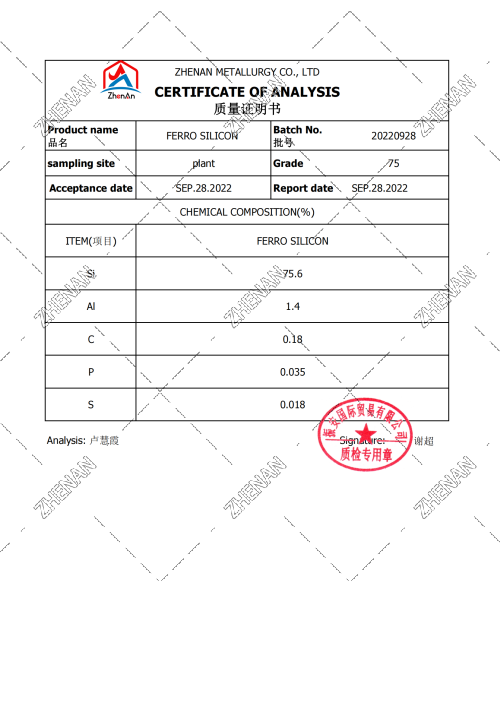
A: Si: 72–78%, Al ≤ 2%, C ≤ 0.2%, P ≤ 0.04%, S ≤ 0.02% (varies by standard).
Q: Is FeSi75 the same as 75% silicon ferrosilicon?
A: Yes; FeSi75 indicates around 75% silicon content in the alloy.
Q: Difference between FeSi75 and FeSi45?
A: FeSi75 has ~75% Si, higher deoxidizing power; FeSi45 has ~45% Si, used where less silicon is needed.
Q: FeSi75 vs FeSi90: Which is better for steelmaking?
A: FeSi75 is common for general steelmaking; FeSi90 offers stronger deoxidation but is costlier and more brittle.
Q: When to use FeSi75 instead of lower/higher silicon ferrosilicon?
A: Use FeSi75 for balanced deoxidation and alloying; choose lower Si for mild adjustment, higher Si for strong deoxidation.
Q: Applications of FeSi75 in steel deoxidation?
A: Removes oxygen as SiO₂, prevents defects, improves cleanliness and mechanical properties.
Q: Why FeSi75 is preferred for producing medium-carbon steel?
A: Provides precise Si addition, good deoxidation, minimal impact on carbon content.
Q: Use of FeSi75 in foundry for gray iron inoculation?
A: Promotes uniform graphite formation, refines grain structure, reduces chill tendency.
Q: Role of FeSi75 in reducing steelmaking costs?
A: Efficient deoxidizer reduces need for other alloys, speeds process, minimizes waste.
Q: Advantages of FeSi75 over other deoxidizers (e.g., aluminum, manganese)?
A: Stronger deoxidation than Mn, less refractory than Al, adds useful Si alloying element.
Q: Disadvantages of using FeSi75 in high-purity steel?
A: Introduces Si impurity, may increase inclusion content, not suitable if ultra-low Si required.
Q: Effect of FeSi75 addition on steel microstructure?
A: Refines grains, can increase ferrite/pearlite ratio, improves strength and toughness.
Q: Melting point and density of FeSi75?
A: Melting point ~1200–1250 °C; density ~4.7–5.0 g/cm³.
Q: Particle size options for FeSi75 (lump, powder, granule)?
A: Available as lump, crushed, granule, and fine powder for different applications.
Q: Impurity levels (Al, Ca, S, P) in industrial-grade FeSi75?
A: Typical: Al ≤ 2%, Ca ≤ 1%, S ≤ 0.02%, P ≤ 0.04% (may vary by spec).
Q: How is FeSi75 produced? (Electric arc furnace process)
A: Smelt quartz (SiO₂) with coke and iron in an electric arc furnace; high temp reduces Si into iron to form ~75% Si alloy.
Q: Key parameters to control Si content in FeSi75 smelting
A: Raw material ratios, furnace temperature, power input, reaction time, slag composition.
Q: Quality testing methods for FeSi75 (e.g., XRF for Si content)
A: XRF for rapid Si analysis, ICP-OES for precise trace elements, wet chemistry for verification.
Q: Factors affecting FeSi75 price (silicon ore cost, energy price)?
A: Silicon ore cost, electricity rates, carbon reductant price, market demand, production capacity.
Q: Optimal dosage of FeSi75 in steelmaking?
A: Determined by steel grade; typically 1–5 kg per ton steel, based on target Si content and deoxidation needs.
Q: How to avoid silicon segregation when using FeSi75?
A: Add uniformly, control melt temperature, ensure good stirring, avoid late excessive addition.
Q: Handling safety precautions for FeSi75 powder?
A: Wear mask/respirator, avoid inhalation, prevent contact with moisture to reduce dust and hydrogen risk, use sealed containers.
硅铁72
Q: What is Ferro Silicon 72 (FeSi72)?
A: An iron–silicon alloy containing about 72% silicon, used for deoxidation, alloying, and inoculation in steel and foundry industries.
Q: Chemical composition of FeSi72 (Si, Fe, impurities)?
A: ~70–74% Si, balance Fe, minor Al (~1–2%), Ca, C, P, S as typical impurities.
Q: Is FeSi72 a standard grade? ASTM/ISO specification?
A: Not always listed separately in ASTM A1006, but covered under ISO 5448 and many mill specs for mid‑range silicon ferrosilicon.
Q: Typical silicon content range for FeSi72 (e.g., 70–74%)?
A: Usually 70–74% Si, nominal 72%.
Q: Difference between FeSi72 and FeSi75 (silicon content, cost, applications)?
A: FeSi72 has slightly lower Si, lower cost, adequate for moderate deoxidation; FeSi75 higher Si, stronger deoxidizer, used where precise Si levels needed.
Q: FeSi72 vs FeSi65: Which is more suitable for foundry inoculation?
A: FeSi72 provides stronger inoculation effect than FeSi65 due to higher Si, often preferred for consistent graphite refinement.
Q: Why choose FeSi72 instead of FeSi75 in some steelmaking processes?
A: Cost savings with acceptable Si addition; avoids excess Si in final steel grade.
Q: Applications of FeSi72 in steel deoxidation and alloying?
A: Removes oxygen as SiO₂, adjusts Si content in carbon and alloy steels, improves cleanliness.
Q: Use of FeSi72 in producing low-alloy steel (e.g., HSLA steel)?
A: Supplies Si for precipitation strengthening, aids deoxidation without overshooting Si target.
Q: Role of FeSi72 in gray iron casting as an inoculant?
A: Promotes uniform graphite flakes, reduces chill, refines grain structure.
Q: Cost-effective scenarios for using FeSi72 in small-scale foundries?
A: When high Si not required; balances performance and price, reduces waste.
Q: Advantages of FeSi72: balance between deoxidation efficiency and cost?
A: Good Si yield, economical, easier handling than very high Si grades.
Q: Limitations of FeSi72 in high-silicon steel production?
A: May require large additions to reach high Si targets, increasing cost and slag volume.
Q: Effect of FeSi72 addition on steel strength and toughness?
A: Increases strength via solid solution hardening; can improve toughness if properly balanced.