Properties of tin ingots
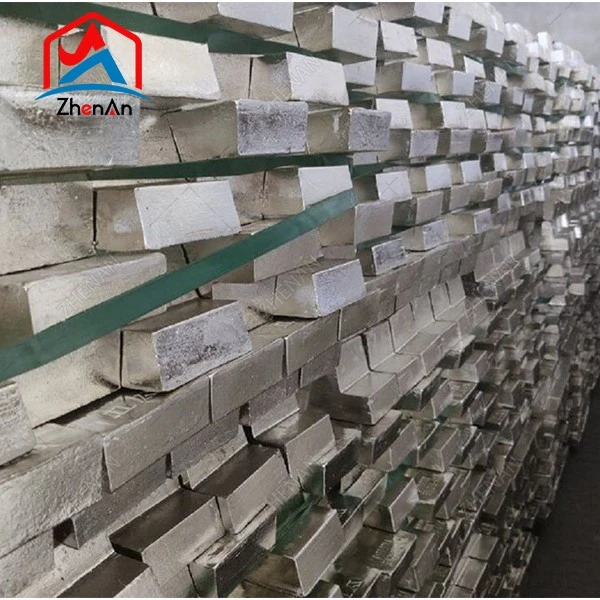
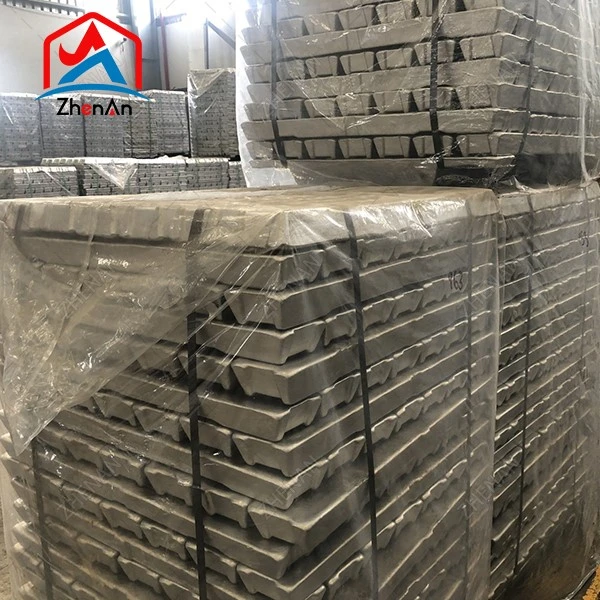
Silver-white metal, soft in texture, and good ductility. Melting point 232℃, density 7.29g/cm3. Non-toxic
|
Grade |
Impurities % max |
|||||||||
|
In |
Cu |
Pb |
Zn |
Cd |
Fe |
Ti |
Sn |
As |
Al |
Total |
|
99.995% |
0.0005 |
0.0006 |
0.0004 |
0.0003 |
0.0003 |
0.0007 |
0.0005 |
0.0007 |
0.0008 |
0.0049 |
Tin is a silvery white and soft metal, which is very similar to lead and zinc, but looks brighter. It has a relatively low hardness and can be cut with a knife. It has good ductility, especially at a temperature of 100℃, it can be expanded into extremely thin tin foil, the thickness can be as thin as 0.04 mm or less.
Tin is also a low melting point metal, its melting point is only 232℃, so it can be melted into a liquid with good fluidity like mercury with a candle flame.
Pure tin has a peculiar property: when tin rods and tin plates are bent, a special bursting sound like crying will be emitted. This sound is caused by the friction between crystals. When the crystal is deformed, such friction will be generated. Strangely, if a tin alloy is used instead, this crying sound will not be emitted when deformed. Therefore, people often use this characteristic of tin to identify whether a piece of metal is tin.