


What is silicon nitride iron?
Customized FeSi3n4 Ferro Silicon Nitride for Steel Industry Innovation

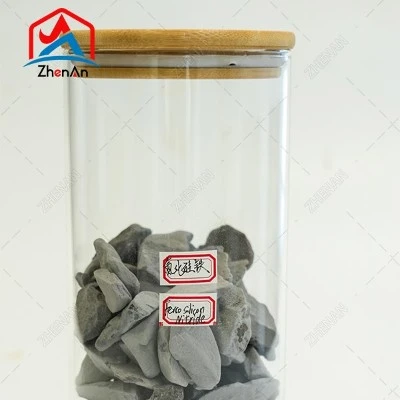


Silicon nitride iron is a compound primarily composed of silicon nitride (Si₃N₄) and containing free iron, unreacted silicon iron, and other impurities.Its main characteristics and applications are as follows:
Main Components
Si₃N₄ accounts for 75%–80% of the material, forming the main component;
Contains 12%–17% free iron (α-Fe) and un-nitrided silicon iron (e.g., Fe₃Si);
Contains trace amounts of impurities such as SiO₂ and Al₂O₃.
Physical Form
Refractory material use: grayish-white or tea-brown powder;
Steel making use: grayish-white granular material.
Core Characteristics
High-temperature stability: withstands temperatures up to 1900°C in a nitrogen atmosphere, but begins to oxidise at 1300°C in air;
Mechanical properties: High hardness (Mohs hardness approximately 8), strong resistance to molten iron erosion;
Thermal properties: Low thermal expansion coefficient (2.35×10⁻⁶/K), good thermal conductivity;
Chemical stability: Resistant to slag erosion, particularly suitable for reducing high-temperature environments.
What is the price of ferrosilicon today?
| Special ferrosilicon prices in major regions of China on July 9 // Ferrosilicon Price Per Ton | |||||
| Unit: Yuan/ton, natural block, ex-factory cash price including tax | |||||
| Mainstream prices of low aluminum ferrosilicon in major regions of China | |||||
| Product Name | Specification | area | price | Rise and Fall | Remark |
| Low Aluminum Ferrosilicon | Si75Al<0.1 | Qinghai | 6700-6750 | -- | Ex-factory price including tax |
| Low Aluminum Ferrosilicon | Si75Al<0.5 | Qinghai | 6400-6450 | -- | Ex-factory price including tax |
| Low Aluminum Ferrosilicon | Si75Al<0.1 | Inner Mongolia | 6700-6750 | -- | Ex-factory price including tax |
| Low Aluminum Ferrosilicon | Si75Al<0.5 | Inner Mongolia | 6400-6450 | -- | Ex-factory price including tax |
| Note: The above prices are for reference only. Enterprises can set prices according to their own circumstances. | |||||
Cutting Tools: Inserts for machining cast iron, nickel alloys, and other hard materials due to its hardness and heat resistance.
Bearings & Rollers: High-performance ball bearings, roller bearings, and wear parts (especially in corrosive/hot environments) because of its low friction, high hardness, and corrosion resistance.
Engine Components: Turbine blades, glow plugs, turbocharger rotors, and other parts exposed to high heat and stress in automotive and aerospace applications.
Metal Forming: Dies, cores, and liners for extrusion (especially aluminum), hot pressing, and welding pins due to thermal shock resistance and non-wetting with molten metal.
Semiconductor Industry: Crucibles, diffusion furnace components, wafer handling parts, and insulator layers (thin films) because of its thermal stability, electrical insulation, and chemical inertness.
Medical Implants: Hip joint balls and other orthopedic implants due to its biocompatibility, wear resistance, and strength.
Armor: Ceramic plates in body armor and vehicle armor for its hardness and ability to shatter projectiles.
Heat Exchangers: Components for high-temperature or corrosive environments.
Substrates: For electronic circuits in demanding environments.
Primary Function:
Ferrosilicon (FeSi): Primarily a deoxidizer and alloying element (adding silicon) in steelmaking. Also a source of silicon in cast iron production.
Silicon Manganese (SiMn): Primarily a deoxidizer and a key alloying element for adding both manganese and silicon simultaneously to steel. Manganese improves strength, toughness, and hardenability.
Composition:
FeSi: Iron (Fe) + Silicon (Si) (typically 65-90% Si, balance mostly Fe).
SiMn: Manganese (Mn) + Silicon (Si) + Iron (Fe) (typically 60-70% Mn, 14-25% Si, 1.5-2.5% C, balance Fe).
Key Element Added:
FeSi: Adds Silicon (Si).
SiMn: Adds Manganese (Mn) and Silicon (Si) together.
Density:
FeSi is significantly less dense (~3.5 g/cm³ for 75% Si) than SiMn (~6.3 g/cm³). This affects how they are added to molten steel.
Steelmaking:
Deoxidizer: Removes dissolved oxygen from molten steel (prevents porosity and brittleness). The most common use.
Alloying Element: Increases strength, hardness, elasticity, and corrosion resistance of steel. Essential for producing silicon steels used in transformer cores and electric motors (due to low hysteresis loss).
Inoculant: Modifies the structure of cast iron, improving strength and ductility.
Foundry (Cast Iron Production):
Inoculant: Added to molten cast iron to promote graphite formation (spheroidal or flake), significantly improving mechanical properties like strength, machinability, and thermal conductivity.
Other Uses:
Reductant: In the production of other ferroalloys (e.g., ferro-magnesium).
Dense Media Separation: Ground FeSi is used in sink-float separation processes in mining (due to its density and magnetism).
Magnesium Production: Used in the Pidgeon process to reduce magnesium oxide.
Welding Electrode Coatings: As a source of silicon.
Hydrogen Production: Reacts with sodium hydroxide.
Visit https://www.metal-alloy.com/ to learn more about the product. If you would like to know more about the product price or are interested in purchasing, please send an email to info@zaferroalloy.com. We will get back to you as soon as we see your message.