


What Is the Main Application of Ferro Vanadium?
The main application of ferro vanadium (FeV) is in steel production, where it is used as a critical alloying element to improve strength, toughness, wear resistance, and grain refinement. By adding small amounts of vanadium into molten steel, manufacturers can significantly enhance mechanical performance while reducing overall alloy consumption. Ferro vanadium is especially essential in producing high-strength low-alloy (HSLA) steels, tool steels, spring steels, and structural steels used in construction, automotive, and energy industries.
Ferro Vanadium Specifications (Standard Grades)
| Grade | V (%) | C (%) | Si (%) | P (%) | S (%) | Al (%) | Size | Application |
|---|---|---|---|---|---|---|---|---|
| FeV 80 | 78–82 | ≤0.5 | ≤1.5 | ≤0.05 | ≤0.03 | ≤2.0 | 10–50 mm | High-strength steel |
| FeV 60 | 58–62 | ≤0.6 | ≤2.0 | ≤0.06 | ≤0.04 | ≤2.5 | 10–50 mm | Alloy steel |
| FeV 50 | 48–52 | ≤0.8 | ≤2.5 | ≤0.08 | ≤0.05 | ≤3.0 | 10–50 mm | General steelmaking |
Form: Lump / crushed
Packaging: 1 MT jumbo bag / steel drum / customized
Why Is Ferro Vanadium Mainly Used in Steelmaking?
Ferro vanadium plays a crucial role in steelmaking because vanadium forms stable carbides and nitrides within the steel structure. These compounds refine grain size, resulting in stronger and more durable steel without significantly increasing weight.
In modern steel production, especially for infrastructure and automotive applications, ferro vanadium enables manufacturers to produce lighter yet stronger steel, which improves performance while reducing material consumption. This makes it both a technical and economic advantage in large-scale production.
Key Applications of Ferro Vanadium in Industry
High-Strength Low-Alloy (HSLA) Steel
The largest application of ferro vanadium is in HSLA steel, where it enhances yield strength and fatigue resistance. This type of steel is widely used in bridges, pipelines, and heavy machinery.
Tool Steel and Wear-Resistant Steel
Vanadium improves hardness and wear resistance by forming vanadium carbides, making it essential in cutting tools, molds, and mining equipment.
Spring Steel and Automotive Steel
In automotive applications, ferro vanadium helps produce high-performance spring steel and lightweight structural components, improving safety and fuel efficiency.
Pipeline and Structural Steel
For oil, gas, and construction industries, ferro vanadium enhances toughness and corrosion resistance, ensuring long-term durability under harsh conditions.
Grade Comparison: FeV 80 vs FeV 60 vs FeV 50
FeV 80 vs FeV 60
FeV 80 contains higher vanadium content, allowing for more precise alloying and better strengthening effect with lower addition rates. It is preferred for high-performance steels. FeV 60 offers a balance between cost and performance, making it suitable for general alloy steel production.
FeV 80 vs FeV 50
FeV 80 is used where strict mechanical properties and consistency are required, such as HSLA steel and automotive steel. FeV 50 is more suitable for bulk steel production, where cost control is prioritized over maximum performance.
FeV 60 vs FeV 50
FeV 60 provides better alloying efficiency and cleaner steel compared to FeV 50, while FeV 50 is mainly used in large-scale, lower-specification steelmaking.
Summary
The primary application of ferro vanadium is in steel alloying, where it significantly improves strength, toughness, and durability. Among all grades, FeV 80 is the most widely used in high-performance steel production, while FeV 60 and FeV 50 serve cost-sensitive applications. Choosing the right grade ensures optimal balance between performance, cost, and production efficiency.
FAQ – Ferro Vanadium Applications
1. What is ferro vanadium mainly used for?
It is mainly used as an alloying additive in steel production to improve strength and durability.
2. Why is vanadium important in steel?
Vanadium refines grain structure and forms carbides, enhancing strength, wear resistance, and toughness.
3. Which industries use ferro vanadium the most?
Steel, construction, automotive, energy, and tool manufacturing industries are the main users.
4. What grade of FeV is best for high-strength steel?
FeV 80 is the best choice due to its high vanadium content and efficiency.
5. Can ferro vanadium reduce steel production costs?
Yes, it allows for lower alloy consumption while achieving higher strength, improving cost efficiency.
6. Is ferro vanadium used in stainless steel?
It can be used in certain stainless and specialty steels to improve mechanical properties and wear resistance.
Get Reliable Ferro Vanadium Supply
We supply FeV 80, FeV 60, and FeV 50 with stable composition, low impurities, and consistent particle size for global steel manufacturers.
📧 Email: market@zanewmetal.com
📱 WhatsApp: +86 15518824805
✔ High vanadium recovery rate
✔ Strict impurity control for clean steel
✔ Bulk supply with fast global delivery
👉 Contact us now for quotation, samples, and technical consultation.
Trusted Ferrovanadium Supplier – Quality · Experience · Stable Supply
All ferrovanadium (FeV) products are produced under strict ISO9001 quality management systems and verified by third-party inspection. COA, SDS, and REACH documents are available to ensure smooth international trade.
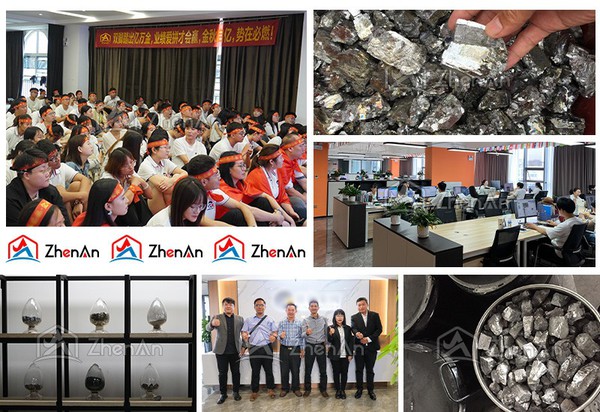
01
30+ Years of Experience
With over three decades in ferroalloy production, ZhenAn has deep expertise in ferrovanadium applications in alloy steel, tool steel, and high-strength structural steel.
02
Stable Composition & Performance
Strict control of vanadium content and impurities (C, Si, P, S, Al) ensures consistent alloying performance, improving strength, toughness, and wear resistance in steelmaking.
03
Reliable Supply & Flexible Specifications
Stable production capacity supports long-term cooperation. Multiple grades (FeV50, FeV60, FeV80) and customized sizes/packaging are available to meet different steel plant requirements.
04
Fast Response & Technical Support
24-hour quotation service with professional technical guidance to support your alloy selection and optimize metallurgical performance.