What Is The Optimal Dosage Of FeSi70 In Basic Oxygen Furnace (BOF) Steelmaking?

Dec 12, 2025

Leave a message


What Is the Optimal Dosage of FeSi70 in Basic Oxygen Furnace (BOF) Steelmaking?

Calculating and Applying FeSi70 for Effective Deoxidation and Alloying in BOF
In BOF steelmaking, FeSi70 is typically added after tapping​ into the ladle, because the BOF itself is not ideal for precise late‑stage alloying due to short blowing time and turbulence.

Dosage Calculation Basics

Determine target Si increase​ in steel:

Δ[Si]=[Si]final​−[Si]initial​

Convert to alloy mass​ using FeSi70 Si content (~70 %):

mFeSi70​=%Si in FeSi70Δ[Si]×Heat Weight​

(Heat weight in tons, Si content as decimal)

Typical Dosage Ranges

Steel Grade / Application
Typical Final Si (%)
Initial Si (%)
ΔSi (%)
FeSi70 Dosage (% of heat weight)
Remarks
Carbon steel (rebar, structural)
0.15–0.25
0.05–0.10
0.10–0.20
0.15–0.30
Common BOF practice
Low‑alloy steel
0.25–0.40
0.05–0.10
0.20–0.35
0.30–0.50
May require split addition
Foundry iron (if BOF used for iron desulfurization)
0.8–1.2
0.2–0.4
0.6–0.8
0.9–1.2
Rare in BOF, more in EAF

Optimal Practice in BOF

Add in ladle​ immediately after tapping starts to ensure good mixing.
Use granulated FeSi70 (3–10 mm)​ for faster dissolution.
Stir​ with argon bubbling or mechanical agitation for 3–5 min post‑addition.
Split addition​ if large Si change needed: part in early ladle, remainder after temperature stabilizes.
Monitor temperature​ (≥ 1600 °C) to ensure complete melting before casting.


How to Avoid Uneven Si Distribution When Using FeSi70 in Large Ladles?

 Ensuring Homogeneous Silicon in High‑Volume Steelmaking
In large ladles​ (e.g., > 100 t), poor mixing can cause local Si enrichment​ or depletion, leading to inconsistent mechanical properties.

Strategies to Ensure Uniform Si Distribution

Strategy
How It Works
Implementation
Proper addition location
Introduce FeSi70 where flow promotes mixing (mid‑ladle depth, not surface)
Use submerged chute or lance for stream addition
Controlled stirring
Argon bubbling creates convection currents that disperse Si
Maintain steady flow rate for 3–8 min post‑addition
Temperature uniformity
Cold spots slow dissolution → uneven Si
Preheat ladle, maintain bath temp > 1600 °C
Particle size selection
Smaller granules dissolve faster and distribute more evenly
Use 1–5 mm granules for large ladles
Multiple point addition
Divide total dose into 2–3 locations
Reduces localized high‑Si zones
Slag coverage
Prevents surface oxidation/re‑absorption of Si
Add slag former after alloying to trap SiO₂
Residence time before tapping
Allows full homogenization
Hold 5–10 min after stirring before casting
Tip:​ In continuous casting tundish treatment, use wire feeding​ of FeSi70 powder for precise, rapid distribution.


What Are the Safety Measures for Handling FeSi70 (Dust Control, Moisture Prevention)?

 Protecting Workers and Material Integrity
FeSi70 in powder or fine granular form​ poses dust inhalation​ and moisture‑reaction​ hazards. Safe handling preserves both worker health​ and product reactivity.

Key Safety Measures

Hazard
Risk
Preventive Measure
Dust inhalation
Respiratory irritation, long‑term lung effects
• NIOSH‑approved respirator (P100 filter) for fine powder handling
• Local exhaust ventilation (LEV) or fume hood
• Avoid creating airborne dust clouds
Moisture reaction
Potential formation of silanes or surface oxidation; clumping
• Store in dry, sealed containers (steel drums, moisture‑proof bags)
• Keep storage area humidity < 40 % RH
• Do not expose to water or high humidity
Skin/eye irritation
Mechanical abrasion from fine particles
• Safety goggles/face shield
• Flame‑resistant gloves
• Long sleeves and coveralls
Fire risk (fine powder in air)
Combustible dust explosion in confined spaces
• Avoid open flames, sparks, hot surfaces
• Ground equipment to prevent static discharge
• Use explosion‑proof lighting in storage/handling areas
Spill response
Dust dispersion, contamination
• Wear full PPE
• Dampen with water or use HEPA vacuum (not dry sweep)
• Dispose per hazardous waste protocol if contaminated

Storage & Handling Best Practices

Keep containers sealed​ until point of use.
Store off damp floors​ on pallets.
Label clearly​ with batch ID, date, and hazard warnings.
Train workers​ in SDS information and emergency procedures.
Rotate stock​ - use oldest material first to minimize aging effects.


Summary Table

Question
Key Points
Optimal dosage of FeSi70 in BOF steelmaking
Calculate from target ΔSi; typical 0.15–0.50 % of heat weight; add in ladle after tapping, use granules, stir well, split addition for large changes.
How to avoid uneven Si distribution in large ladles
Add at mid‑depth, use controlled stirring, maintain uniform temperature, use fine granules, multiple point addition, allow residence time before casting.
Safety measures for handling FeSi70
Control dust (respirators, LEV), prevent moisture (sealed dry storage), protect skin/eyes, avoid ignition sources, follow spill protocols, train workers.


Ferrosilicon FAQ

China Metallurgy Application Ferro Silicon / Ferrosilicon for Pure Ferro Silicon 75% for Steel and Iron Industry at Competitive Prices

Ferro Silicon 75
Ferro Silicon 72
Ferro Silicon 70
Ferro Silicon 75

Q: What is Ferro Silicon 70 (FeSi70)?
A: An iron–silicon alloy with ~70% Si, used for deoxidation and alloying in general steelmaking and foundries.


Q: Chemical composition of FeSi70 (typical Si, Fe, and impurity levels)?
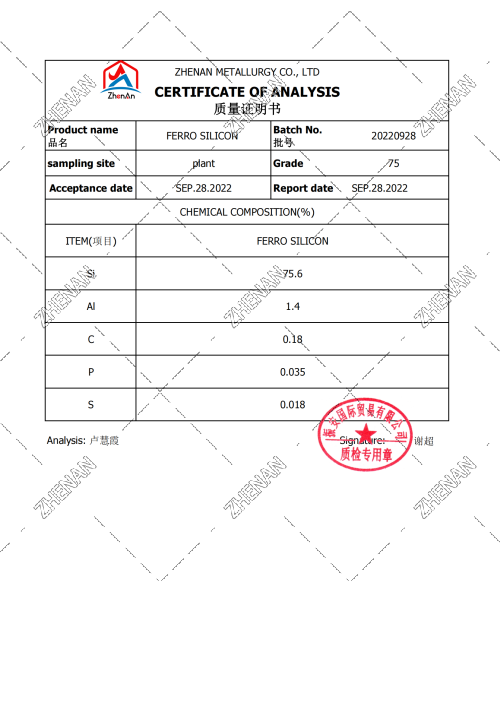
A: ~68–72% Si, balance Fe, impurities: Al ≤ 2%, Ca ≤ 1%, C ≤ 0.2%, P ≤ 0.04%, S ≤ 0.02%.


Q: Is FeSi70 a recognized industrial grade? ASTM/GB standards?
A: Not in ASTM A1006; covered in GB/T 2272 (China) and ISO 5448 as a medium‑Si grade.


Q: Silicon content range for FeSi70 (e.g., 68–72%)?
A: Typically 68–72% Si, nominal 70%.


Q: Difference between FeSi70 and FeSi72 (Si content, cost, deoxidation efficiency)?
A: FeSi70 lower Si, lower cost, slightly less efficient deoxidation than FeSi72.


Q: FeSi70 vs FeSi65: Which is better for low-silicon steel production?
A: FeSi65 better for very low Si targets; FeSi70 gives more Si per unit, so must be dosed carefully.


Q: Why choose FeSi70 over higher silicon grades in cost-sensitive applications?
A: Lower purchase price, sufficient Si for standard requirements, reduced alloy cost.


Q: Applications of FeSi70 in general steelmaking (e.g., carbon steel deoxidation)?
A: Removes oxygen in BOF/EAF, adjusts Si in carbon steels.


Q: Use of FeSi70 in foundry for heavy-section cast iron?
A: Inoculation to prevent chill, promote uniform graphite.


Visit https://www.metal-alloy.com/ to learn more about the product. If you would like to learn more about the product price or are interested in purchasing, please email market@zanewmetal.com. We will get back to you as soon as we see your message.
 

Get a Quote Today


Iron Silicon Alloy With 75 Silicon Silver Grey Powder For High Strength Alloy Steel Making

🏭 Why Choose ZhenAn?


We understand the common pain points in Ferro Silicon sourcing today:
•High local cost and unstable supply
•Long lead times affecting project schedules
•Incomplete product ranges
•Slow communication and lack of follow-up


We Help Solve These Problems With:
✅ Large stock ready for fast delivery
✅ One-stop sourcing for Ferro Silicon, silicon metal, Silicon Metal Powder , and more
✅ Strict quality control with international standards
✅ Experienced sales team with fast response and clear communication

We'd love to learn more about your needs and offer you competitive prices and efficient service.
 

one-stop solution

professional team

high quality