What is the price of FeSi?China's export price of ferrosilicon on April 27, 2026
| China's export price of ferrosilicon on April 27, 2026 | ||||
| Unit: US dollars/ton | ||||
| product | Brand | Quotation | rise and fall | Remark |
| Ferrosilicon | 72 | 1140-1160 | -- | FOB Tianjin Port |
| Ferrosilicon | 75 | 1180-1210 | -- | FOB Tianjin Port |
What is Ferrosilicon and What Is It Used For in Steelmaking?
What is ferrosilicon and why is it widely used in steelmaking?
Ferrosilicon (FeSi) is an iron–silicon alloy produced by reducing silica (SiO₂) with coke in the presence of iron in an electric arc furnace. It typically contains 15%–90% silicon, with the most common industrial grade being FeSi 75%.

In steelmaking, ferrosilicon is primarily used as a strong deoxidizer, alloying agent, and heat stabilizer. It removes oxygen from molten steel, improves steel cleanliness, and enhances strength, elasticity, and corrosion resistance.
Because of its efficiency and cost-effectiveness, ferrosilicon is a core material in carbon steel, stainless steel, cast iron, and alloy steel production, making it indispensable in modern metallurgy.
What are the specifications and technical parameters of ferrosilicon?
| Item | Specification |
|---|---|
| Product Name | Ferrosilicon (FeSi) |
| Silicon Content | 45% / 65% / 75% / 90% |
| Common Grade | FeSi 75% |
| Iron Content | Balance |
| Carbon Content | ≤ 0.2% (varies by grade) |
| Particle Size | 10–50 mm / 50–100 mm / customized |
| Appearance | Metallic grey lump |
| Melting Point | ~1200–1250°C |
| Application | Steelmaking, casting, foundry |
| Packaging | 1MT big bags / bulk |
Ferrosilicon is widely supplied by a professional Ferrosilicon manufacturer, especially in major production regions such as China, where large-scale production ensures stable global supply.
How does ferrosilicon work in steelmaking and foundry applications?
In steelmaking, ferrosilicon acts as a primary deoxidizer. Oxygen in molten steel can cause porosity, brittleness, and reduced mechanical performance. Ferrosilicon reacts with oxygen to form silica, which is removed as slag, resulting in cleaner steel.
It also serves as a silicon alloying source, improving steel elasticity, magnetic properties, and corrosion resistance. This is particularly important in electrical steel and spring steel production.
In foundry applications, especially gray iron casting, ferrosilicon is used as an inoculant. It refines graphite structure, improves casting density, and reduces shrinkage defects. This makes it a key material in automotive parts, machinery components, and heavy industrial castings.
From an industrial procurement perspective, stable supply from a reliable Ferrosilicon supplier directly impacts furnace efficiency and casting quality consistency.
What is the difference between FeSi 75 and FeSi 65?
FeSi 75 is the most widely used grade in steelmaking. It contains about 75% silicon and offers strong deoxidation performance with balanced cost efficiency. It is commonly used in both steel plants and foundries.
FeSi 65 has lower silicon content and is often used in applications where deoxidation strength requirements are slightly lower or cost optimization is needed. It is also used in some cast iron production processes.
In comparison:
FeSi 75 = stronger deoxidation, more stable steel quality, standard steelmaking grade
FeSi 65 = lower cost, moderate performance, specific casting applications
Most global buyers prefer FeSi 75 due to its balance of performance and availability from FeSi 75 supplier China markets.
What is the difference between FeSi 75 and high silicon ferrosilicon (FeSi 90)?
FeSi 75 is the standard industrial grade used in most steelmaking and foundry operations. It provides a balance between silicon content, cost, and melting efficiency.
FeSi 90 contains a much higher silicon concentration and is mainly used in special alloy production, chemical reduction processes, and high-grade applications where strong silicon reactivity is required.
Key differences:
FeSi 75 = general steelmaking, cost-effective, widely available
FeSi 90 = high silicon content, specialized industrial use, higher cost
Due to production complexity, FeSi 90 is more expensive and less commonly used compared to standard grades supplied by a typical deoxidizer ferrosilicon manufacturer.
What is the difference between ferrosilicon and other ferroalloys?
Ferrosilicon is primarily a silicon-based ferroalloy used for deoxidation and alloying, while other ferroalloys like ferromanganese or ferrotitanium focus on different elements such as manganese or titanium.
Compared to ferromanganese:
Ferrosilicon removes oxygen more efficiently due to silicon's strong affinity for oxygen
Ferromanganese mainly adds manganese and controls sulfur and carbon behavior
Compared to ferrotitanium:
Ferrosilicon is mainly used for deoxidation and alloy stabilization
Ferrotitanium is used for grain refinement and nitrogen control
This makes ferrosilicon one of the most versatile materials in steelmaking, widely sourced from global silicon iron alloy suppliers.
Why is ferrosilicon essential in modern metallurgy?
Ferrosilicon is a core ferroalloy in steelmaking and casting industries due to its strong deoxidation capability and silicon alloying function. It improves steel purity, mechanical performance, and casting quality while remaining cost-efficient.
From construction steel to precision alloys and foundry castings, ferrosilicon plays a critical role in ensuring consistent metallurgical performance. Its versatility makes it one of the most widely used materials in global steel production systems.
FAQ
1. What is ferrosilicon used for in steelmaking?
It is used to remove oxygen from molten steel and improve strength, elasticity, and corrosion resistance.
2. What is the most common ferrosilicon grade?
FeSi 75 is the most widely used grade due to its balanced performance and cost efficiency.
3. What affects ferro silicon price per ton?
Silicon content, raw quartz cost, electricity consumption, and global steel demand influence pricing.
4. Is ferrosilicon used in casting?
Yes, it is widely used as an inoculant in gray iron casting to improve structure and reduce defects.
5. What is the difference between FeSi 75 and FeSi 65?
FeSi 75 has higher silicon content and stronger deoxidation ability, making it more suitable for steelmaking.
6. Why choose a China ferrosilicon supplier?
China offers large-scale production, stable quality, and competitive pricing for global ferroalloy buyers.
Looking for a reliable Ferrosilicon supplier?
If you are sourcing a stable Ferrosilicon manufacturer, we provide consistent quality, competitive pricing, and global export support for steel mills and foundries.
We supply:
FeSi 75 / FeSi 65 / FeSi 90
Foundry grade ferrosilicon
Customized silicon iron alloy products
📩 Email: market@zanewmetal.com
📱 WhatsApp: +86 15518824805
Get latest Ferro silicon price per ton, technical specifications, and bulk quotation directly from a trusted FeSi 75 supplier China and global Ferrosilicon supplier.
Third-party inspection available
Why Choose ZhenAn Ferrosilicon 75 & 72?
For global steelmakers, FeSi 75 and FeSi 72 are mainly evaluated based on silicon stability, deoxidation efficiency, impurity control, and production consistency. ZhenAn focuses on delivering reliable performance across both grades.
1. Stable Silicon Grades for Different Processes
FeSi 75 provides higher silicon content for stronger deoxidation efficiency, while FeSi 72 offers more flexible application in general steelmaking and casting processes.
2. Efficient Deoxidation Performance
Both grades effectively remove oxygen from molten steel, improving steel purity and supporting better mechanical properties in final products.
3. Controlled Impurities for Cleaner Steel
Strict control of elements such as Al, C, and S helps reduce inclusions and ensures more stable steel quality.
4. Consistent Particle Size for Industrial Use
Uniform sizing improves melting speed and dosing accuracy, supporting efficient furnace operation and automated production systems.
5. Reliable Supply with Export Support
ZhenAn ensures stable production capacity, timely delivery, and full documentation (COA, SDS) for international procurement.
ZhenAn FeSi 75 and 72 provide buyers with stable silicon performance, reliable metallurgical results, and consistent supply, suitable for modern steelmaking and foundry applications.
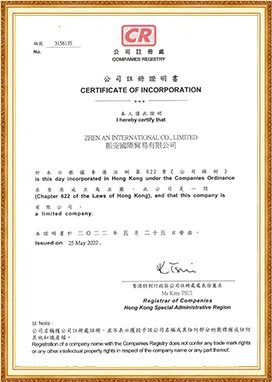
ZhenAn Metallurgy & New Materials Certificates