What is ferromanganese and why is it important in steelmaking?
Ferromanganese is an iron–manganese alloy widely used in steel production as a deoxidizer, desulfurizer, and alloying element source. It is produced by smelting manganese ore with iron in a high-temperature furnace. Its main function is to improve steel quality by removing oxygen and sulfur impurities while increasing strength, hardness, and wear resistance.
In practical steelmaking, ferromanganese is indispensable. Without it, molten steel would contain excessive impurities, leading to brittleness, cracking, and unstable mechanical performance. This is why every steel plant depends on a stable Ferromanganese supplier to ensure consistent production quality.
What are the specifications and technical parameters of ferromanganese?
| Item | Specification |
|---|---|
| Product Name | Ferromanganese (FeMn) |
| Mn Content | 60% – 85% |
| Carbon Content | 0.1% – 8.0% (varies by grade) |
| Size Range | 10–50 mm / 10–100 mm / customized |
| Melting Point | 1200–1350°C |
| Function | Deoxidation, desulfurization, alloying |
| Packaging | 1MT big bag / bulk / drum |
| Application | Steelmaking, foundry, alloy production |
Ferromanganese is available in multiple grades, including High carbon ferromanganese, Medium carbon ferromanganese, and Low carbon ferromanganese, each serving different steelmaking requirements.
How does ferromanganese work in steelmaking processes?
During steel refining, oxygen and sulfur are harmful impurities that reduce steel performance. Ferromanganese reacts with these elements, forming stable compounds that are removed into slag, resulting in cleaner steel.
At the same time, manganese dissolves into molten steel and acts as an essential alloying element. It improves hardenability, tensile strength, and structural stability without compromising ductility.
In modern metallurgy, steel producers carefully select grades based on end-use requirements. A reliable Ferro manganese manufacturer China ensures stable composition, which directly affects furnace efficiency and final steel consistency.
What is the difference between High Carbon and Medium Carbon Ferromanganese?
High carbon ferromanganese (HC FeMn) contains higher carbon levels, typically 6%–8%. It is widely used in bulk steel production due to its cost advantage and strong deoxidation ability. However, it is not suitable for low-carbon or precision steel grades.
Medium carbon ferromanganese (MC FeMn) has controlled carbon content (around 1%–2%). It is used in higher-grade steels where carbon control is critical. It provides better metallurgical precision and is preferred in alloy steel and special steel production.
From a purchasing perspective, HC FeMn is more economical, while MC FeMn ensures higher purity and stricter chemical control. Choosing between them depends on production cost targets and steel grade requirements.
What is the difference between High Carbon and Low Carbon Ferromanganese?
High carbon ferromanganese is used in standard steelmaking where cost efficiency is prioritized. It introduces both manganese and carbon into the melt, making it suitable for general construction and structural steels.
Low carbon ferromanganese is used in high-end applications such as stainless steel and tool steel. It provides manganese without significantly increasing carbon content, making it essential for controlled chemistry steel grades.
Because low carbon grades require advanced refining processes, their production cost is significantly higher than HC FeMn.
What is the market value and price trend of ferromanganese per ton?
The Ferromanganese price per ton is influenced by manganese ore cost, energy consumption, carbon grade, and global steel demand. HC FeMn is generally the most cost-effective option, while MC and low carbon grades command higher prices due to refining complexity.
In recent market trends, price fluctuations are closely tied to steel production cycles and raw material availability. Buyers often lock contracts with long-term suppliers to stabilize procurement costs.
Summary: Why is ferromanganese essential in modern metallurgy?
Ferromanganese is a core alloy that ensures steel purity, stability, and mechanical strength. It plays a dual role in removing harmful impurities and enhancing manganese content in steel. Different grades-HC, MC, and low carbon-allow steelmakers to fine-tune composition based on performance and cost requirements.
Without ferromanganese, modern steel production would not achieve consistent quality or mechanical reliability.
FAQ – What do buyers usually ask about ferromanganese?
1. What is ferromanganese mainly used for?
It is used in steelmaking to remove oxygen and sulfur and to improve steel strength and hardness. It is a core alloy in almost all steel grades.
2. What is the difference between HC FeMn and MC FeMn?
HC FeMn has higher carbon and lower cost, while MC FeMn offers better chemical control for high-grade steels.
3. What manganese content is typical in ferromanganese?
Most commercial products contain 60%–85% manganese depending on grade and application.
4. Can ferromanganese be used in stainless steel?
Yes, but mainly low carbon or medium carbon grades are used to avoid excess carbon contamination.
5. What factors affect ferromanganese price per ton?
Raw ore cost, energy price, carbon grade, and global steel demand are the main factors.
6. How is ferromanganese added in steel production?
It is added during ladle refining or furnace smelting stages to adjust composition and remove impurities.
Looking for a reliable Ferromanganese supplier?
If you are sourcing from a stable Ferro manganese manufacturer China, we provide consistent quality, competitive pricing, and global export support.
We supply HC FeMn, MC FeMn, and customized grades for steel mills and foundries worldwide.
📩 Email: market@zanewmetal.com
📱 WhatsApp: +86 15518824805
Get latest Ferromanganese price per ton, technical specifications, and bulk quotation directly from a trusted HC FeMn supplier and MC FeMn exporter.
What is the price of ferro manganese?
| Summary of China's Ferromanganese Market as of April 27, 2026 | |||
| Unit: Yuan/ton, ex-factory cash price including tax (for reference only) | |||
| 1) High-carbon ferromanganese | |||
| Brand | area | Today's mainstream ex-factory transaction price | Average price change |
| femn65c7.0 | Sichuan (p<0.25) | -- | -- |
| Guizhou (p<0.2) | -- | -- | |
| Guangxi (p<0.2) | 5500-5600 | -- | |
| Shanxi (p<0.2) | 5650-5700 | -- | |
| Henan (p<0.2) | -- | -- | |
| Inner Mongolia (p<0.2) | 5600 | -- | |
| Jiangsu (p<0.2) | 5800-5900 | -- | |
| Shandong (p<0.2) | 5650-5700 | -- | |
| Shanghai (p<0.2) | 5800-5900 | -- | |
| Tianjin (p<0.2) | 5800-5900 | -- | |
| Liaoning (p<0.2) | -- | -- | |
| femn75c7.0 | Yunnan (p<0.3) | -- | -- |
| Yunnan (p<0.2) | 6300-6400 | -- | |
| Yunnan (p<0.15) | -- | -- | |
| Guangxi (p<0.25) | 6300-6400 | -- | |
| Hunan (p<0.25) | -- | -- | |
| Guizhou (p<0.25) | -- | -- | |
| Inner Mongolia (p<0.25) | 5900 | -- | |
| Zhejiang (p<0.25) | 6700-6800 | -- | |
| Zhejiang (p<0.15) | 6700-6800 | -- | |
| Shanghai (p<0.25) | 6700-6800 | -- | |
| 2) Blast furnace ferromanganese | |||
| product | Brand | Today's mainstream ex-factory transaction price | Average price change |
| blast furnace ferromanganese | femn65c7.0 | 5600 | -- |
| 3) Medium-carbon ferromanganese | |||
| Brand | area | Today's mainstream ex-factory transaction price | Average price change |
| femn75c2.0P<0.35 | Guizhou | -- | -- |
| Guangxi | -- | -- | |
| Guizhou (P<0.2) | {=MT1001-GZ2CJ} | {=MT1001-ZD_GZ2CJC} | |
| femn75c2.0P<0.25 | Guizhou | 7800-7900 | -- |
| Guangxi | 7800-7900 | -- | |
| Hunan | 7800-7900 | -- | |
| Henan | 7800-7900 | -- | |
| Inner Mongolia | 7800-7900 | -- | |
| femn75c2.0P<0.2 | Zhejiang | 8200-8300 | -- |
| 4) Low-carbon ferromanganese: | |||
| Brand | area | Today's mainstream ex-factory transaction price | Average price change |
| FEMN80C0.7 Group II Phosphorus | Guizhou | 9700-9800 | -- |
| Hunan | 9700-9800 | -- | |
| Shanxi | 9700-9800 | -- | |
| FEMN80C0.7 group of phosphorus | Guizhou | 9800-9900 | -- |
| FEMN80C0.4 Group II Phosphorus | Hunan | 10100-10200 | -- |
| FEMN80C0.4 group of phosphorus | Hunan | 10200-10400 | -- |
| Henan | 10200-10400 | -- | |
Third-party inspection available
Why Choose ZhenAn Ferromanganese?
For global steel producers, ferromanganese (FeMn) is evaluated based on deoxidation efficiency, manganese recovery rate, composition stability, and supply reliability. ZhenAn focuses on these key industrial priorities.
1. Stable Manganese Content Options
ZhenAn supplies different FeMn grades (such as medium carbon and high carbon), ensuring consistent Mn performance for various steelmaking requirements.
2. Efficient Deoxidation and Desulfurization
Ferromanganese plays a critical role in removing oxygen and sulfur, improving steel cleanliness and enhancing final mechanical properties.
3. Controlled Impurity Levels
Strict control of elements like P and S helps reduce defects and supports higher-quality steel production.
4. Consistent Batch-to-Batch Quality
Stable production processes ensure uniform chemical behavior, supporting continuous furnace operations without performance fluctuation.
5. Reliable Export Supply System
ZhenAn offers stable delivery capacity and full export documentation (COA, SDS), ensuring smooth international procurement.
ZhenAn ferromanganese provides buyers with stable composition, reliable metallurgical performance, and consistent supply, meeting the core requirements of modern steel production.
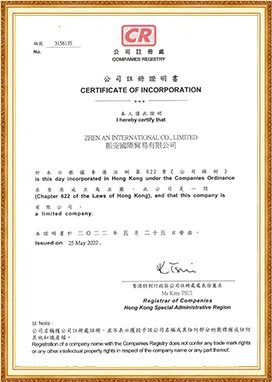
ZhenAn Metallurgy & New Materials Certificates