What Is The Price Of Ferro Silicon Today?

Dec 02, 2025

Leave a message

What is the price of ferrosilicon today?


Today's price of ferrosilicon exported from China //  China Ferrosilicon spot price
Unit: US dollars/ton
product Brand Quotation rise and fall Remark
Ferrosilicon 72 1020-1040 -- FOB Tianjin Port
Ferrosilicon 75 1100-1120 -- FOB Tianjin Port


Latest Updates from the Chinese FeSi Markets

Today's price of special ferrosilicon in China
Unit: Yuan/ton, natural blocks, ex-factory cash price including tax
Mainstream prices of low-aluminum ferrosilicon in major regions of China
Product Name Specification area price rise and fall Remark
Low-aluminum ferrosilicon Si75Al<0.1 Qinghai 6700-6750 -- Ex-factory price including tax
Low-aluminum ferrosilicon Si75Al<0.5 Qinghai 6400-6450 -- Ex-factory price including tax
Low-aluminum ferrosilicon Si75Al<0.1 Inner Mongolia 6700-6750 -- Ex-factory price including tax
Low-aluminum ferrosilicon Si75Al<0.5 Inner Mongolia 6400-6450 -- Ex-factory price including tax
Note: The prices above are for reference only. Companies can set their own prices based on their own circumstances.


Ferro Silicon  75
What is Ferro Silicon Used For?
Key Applications of Ferro Silicon in Metallurgy and Industry
Ferro silicon (FeSi) is a ferroalloy composed of iron and silicon, typically containing 15–90% silicon, with the remainder being iron. It is widely used in steelmaking, cast iron production, and other metallurgical processes due to its deoxidizing and alloying properties.
Application Area
Function
Steelmaking
Deoxidizer to remove oxygen from molten steel
Alloy Production
Increases silicon content in steel and cast iron
Cast Iron Inoculation
Controls graphite formation and prevents chill
Manufacturing Electrical Steel
Enhances magnetic permeability and electrical resistivity
Welding Electrodes
Acts as a stabilizer and slag former
In steelmaking, ferro silicon is added to molten metal to react with oxygen, forming silica that floats as slag and purifies the steel. This improves steel cleanliness and mechanical properties such as strength and ductility. It is also used to introduce silicon into steel, which boosts hardness and magnetic characteristics, making it valuable in transformer and motor core production.
In cast iron, small additions of FeSi inoculate the melt, promoting uniform graphite distribution and preventing the formation of brittle cementite. This improves machinability and reduces shrinkage defects. FeSi is available in various grades depending on silicon content, allowing customization for specific industrial needs. Its low melting point relative to many ferroalloys facilitates easier handling and faster dissolution in melts. Overall, ferro silicon is essential for producing high-quality metals and components in construction, automotive, and electrical industries.


What is the Use of FeSi?
Practical Roles of FeSi Across Industries
FeSi, shorthand for ferro silicon, serves multiple practical purposes owing to its chemical reactivity and alloying capabilities. Its main use lies in metallurgy, but it also finds niche applications in chemical and manufacturing sectors.
Use Category
Role of FeSi
Benefits
Deoxidation in Steel
Removes O₂ to prevent porosity and weakness
Cleaner, stronger steel
Alloying Agent
Adds silicon to adjust steel/iron properties
Tailors hardness, magnetism, corrosion resistance
Inoculant in Cast Iron
Promotes graphite nucleation
Prevents hard spots, improves machinability
Reducing Agent
Used in production of other metals (e.g., chromium)
Lowers energy and cost in metal extraction
Chemical Feedstock
Source of silicon in silicone polymer manufacture
Enables silicone rubber and resin production
In steel ladles, FeSi rapidly scavenges oxygen, reducing inclusions and improving fluidity. When added to foundry melts, it refines grain structure and controls solidification patterns. In non-ferrous metallurgy, FeSi reduces metal oxides to pure metals economically. Its silicon content is also harnessed in chemical synthesis, notably for silicones used in sealants, lubricants, and medical devices.
FeSi is chosen over pure silicon because it is cheaper, safer to handle, and dissolves more readily in melts. Different grades (e.g., FeSi75, FeSi45) match specific process requirements, balancing silicon concentration with cost. By enabling precise control over metal chemistry and microstructure, FeSi enhances product performance and manufacturing efficiency across a spectrum of industries.
Ferro Silicon  72
What is Another Name for Ferrosilicon?
Alternative Names and Classifications of Ferro Silicon
Ferrosilicon is also known by several alternative names reflecting its composition, production method, or regional usage. These synonyms facilitate identification in trade, technical literature, and industrial contexts.
Alternative Name
Context / Reason
Ferro Silicon
Standard international term
FeSi
Chemical symbol abbreviation
Silicon Iron
Emphasizes elemental constituents
Ferosil
European variant spelling
Silicon Alloy
General classification
In commerce and metallurgical specifications, FeSi is the most common abbreviated form, simplifying documentation and communication. "Silicon iron" highlights the binary nature of the alloy, useful in academic and engineering discussions. "Ferosil" appears in older European texts and some non-English markets, preserving historical nomenclature.
Ferrosilicon is classified by silicon content, leading to designations like FeSi75 (75% Si) or FeSi45 (45% Si). These grades indicate purity and application scope. Regional producers may use local language terms, but the core identity remains tied to its iron–silicon matrix.
Understanding these names helps buyers, engineers, and researchers navigate specifications and source the correct material for their processes. Regardless of terminology, the alloy's function as a deoxidizer and alloying agent remains consistent across industries.


What is the Difference Between Silicon and Ferrosilicon?
Comparing Elemental Silicon and Its Alloy with Iron
Silicon (Si) is a chemical element, while ferrosilicon (FeSi) is an alloy of silicon and iron. Their differences span physical form, reactivity, handling, and industrial application.
Parameter
Silicon
Ferrosilicon
Chemical Nature
Pure element (≥98%)
Alloy (Si 15–90%, Fe balance)
Form
Crystalline solid, powder, lump
Lump, granules, briquettes
Reactivity
Highly reactive with oxygen and moisture
Less reactive due to iron matrix
Melting Point
~1414°C
~1200–1300°C (depends on Si%)
Primary Use
Semiconductors, solar cells, silicones
Steelmaking, cast iron inoculation
Handling
Requires protection from oxidation
Easier to handle, safer in melts
Cost
Higher for high-purity grades
More economical for metallurgical use
Pure silicon is a brittle metalloid used in electronics and photovoltaic industries, where extreme purity is essential. In contrast, ferrosilicon is produced as a cost-effective source of silicon for metallurgy. The iron in FeSi moderates silicon's reactivity, allowing safe addition to molten metal without excessive fuming or oxidation.
In steelmaking, adding FeSi instead of pure silicon achieves the same silicon content with fewer process complications. FeSi also acts as a deoxidizer, whereas pure silicon alone would require special conditions to avoid violent reactions. Thus, ferrosilicon bridges the gap between elemental silicon's properties and industrial-scale metal treatment needs, providing a practical compromise of performance, safety, and economy.


Visit https://www.metal-alloy.com/ to learn more about the product. If you would like to learn more about the product price or are interested in purchasing, please email market@zanewmetal.com. We will get back to you as soon as we see your message.
 

Get a Quote Today


Iron Silicon Alloy With 75 Silicon Silver Grey Powder For High Strength Alloy Steel Making

🏭 Our Strengths


We have a strong foundation and a customer-focused service attitude. Our products are exported to Europe, Asia, Africa, Australia, and South America, earning high customer satisfaction.
Additionally, we have a professional R&D and sales team, as well as our own factory and laboratory.
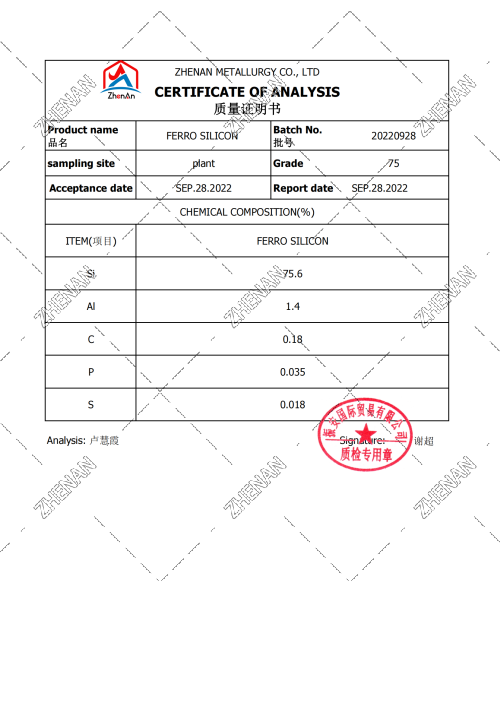
Each batch of products undergoes rigorous inspection by our quality control team.
After passing a series of tests, our products are delivered to customers, ensuring quality assurance.
We offer customized products with different contents, standards, and specifications tailored to customer needs.

one-stop solution

professional team

high quality